
The 2026 Breakdown: What to Expect From an Emergency Tree Service
Short answer: A true emergency (a tree threatening a structure, blocking your only exit, or touching a power line) gets priority dispatch, usually at two to three times standard labor rates [S1][S2]. A tree already down but clear of anything critical can typically wait for a scheduled, standard-rate visit. If a power line is involved, call the utility company first, not a tree crew [S4].
The CompareTreeServices Take
Free estimates make homeowners lazy and crews vague. Use this guide to arrive specific: a crew that hears exact scope gives an exact number, and exact numbers are comparable.
| Situation | What to expect | Priority |
|---|---|---|
| Tree on a house, garage, or vehicle | Same-day dispatch, emergency pricing | Highest |
| Tree touching or near a power line | Utility company handles the line first, then a tree crew | Highest, utility-led |
| Tree blocking your only driveway or exit | Same-day or next-day dispatch | High |
| Tree down, clear of structures and access | Scheduled visit at standard rates | Normal |
| Leaning or cracked tree, not yet fallen | Same-day assessment recommended, removal may be scheduled | High to normal, depends on lean |
Sources for this table: S4 in the Sources list below.
Table of Contents
What actually counts as an emergency
Not every fallen tree is an emergency, and that distinction is the biggest lever on your bill. A real emergency threatens a person, a structure, a power line, or your only way in or out: a trunk cracked and leaning onto a roof, a limb hung up over your driveway, or a tree resting on a line. Those situations justify paying for immediate dispatch. A tree already on the ground with nothing underneath it, or a tree merely leaning with no clear fall path toward anything, can usually wait for a standard appointment. See our emergency tree removal cost guide for the full pricing breakdown once you know which category you’re in.
If a power line is involved, call the utility first
This one rule matters more than any other on this page: if a tree or branch is touching, arcing near, or resting on a power line, call your utility company before anyone else, then call 911 if there’s immediate danger. Never approach a downed line or a tree tangled in one; assume every line is energized. FirstEnergy’s homeowner safety guidance puts it plainly: stay back, survey from a distance, and report it, since a downed line can energize the ground and nearby objects well beyond the wire itself [S4]. Our tree removal near power lines guide covers who’s responsible for what once the utility clears the hazard.
What you’ll pay for speed
Emergency dispatch isn’t priced like a scheduled job, and it shouldn’t be: you’re paying a crew to drop another job or work outside normal hours, not just cut down a tree. HomeGuide puts urgent, after-hours tree service at $150 to $250 an hour, and says same-day or next-day response often runs two to three times a scheduled job’s total cost [S1]. Angi and HomeAdvisor both note an after-hours premium of roughly $100 to $150 an hour on top of standard labor [S2][S3]. During an active storm event, a single wind or ice storm can put every local crew on back-to-back calls, and This Old House found genuinely urgent jobs can run as high as $5,000 once demand and after-hours dispatch stack together [S5]. That premium pays for standby crews and insured equipment on short notice, not padding.
What to have ready when you call
A dispatcher can triage faster with a few specifics up front: whether the tree is touching a structure, a vehicle, or a line; whether it’s blocking your only way out; how many people or pets are near it; and a couple of photos taken from a safe distance if you can get them. That information is what separates a same-day dispatch from a scheduled callback, and it lets the company send the right crew and equipment the first time instead of reassessing on-site.
Avoiding storm-chaser scams
Storm damage reliably draws traveling crews and door-knockers into hit neighborhoods offering same-day work, and some carry no insurance and no intention of standing behind the job. Georgia’s Attorney General consumer protection office recommends getting written bids from multiple contractors when you can and staying skeptical of a bid that seems too low or a crew that demands cash up front, advice built for exactly this situation [S6]. A legitimate crew hands over a certificate of insurance covering general liability and workers’ comp without hesitation; a storm-chaser stalls, or won’t provide one at all. Confirm the lead climber’s credentials too. An ISA Certified Arborist working under ANSI Z133 safety rules is a different level of judgment than whoever knocked on your door an hour after the wind died down.
Getting quotes from tracked pros
Even under time pressure, you’re better off choosing from crews that have already been checked than gambling on whoever shows up first. Every pro in our directory has cleared our listing standards, including proof of insurance, so an emergency call doesn’t mean skipping the verification step; we’ve already done it.
Key takeaways
- A true emergency threatens a structure, a person, your only exit, or a power line; a fallen tree clear of all four can usually wait for standard pricing.
- If a power line is involved, call the utility company first, always, before any tree crew [S4].
- Emergency and after-hours dispatch typically runs $100 to $250 an hour above standard labor, or two to three times a scheduled job’s total cost [S1][S2][S3].
- Have photos, hazard details, and access information ready when you call to speed up triage.
- Storm-chasers target damaged neighborhoods; verify insurance and an ISA Certified Arborist credential before hiring anyone you didn’t seek out yourself [S6].
Frequently asked questions
How do I know if I need emergency tree service?
If a tree is threatening a structure, a person, a power line, or your only way in or out of your property, that’s a genuine emergency worth paying for immediate dispatch. A tree already down and clear of anything critical is usually a scheduling decision, not an emergency one.
How much more does emergency tree service cost?
Expect $100 to $250 an hour above standard labor rates, with same-day or after-hours jobs commonly running two to three times a scheduled job’s total cost [S1][S2][S3]. Storm-surge pricing during a major weather event can push urgent jobs as high as $5,000 [S5].
What should I do first if a tree falls on a power line?
Stay at least 30 feet back, keep everyone else away, and call your utility company immediately, then 911 if there’s active danger. Never approach a downed line or a tree resting on one; assume it’s energized until a professional confirms otherwise [S4].
How do I avoid getting scammed after a storm?
Get a certificate of insurance before anyone starts, treat a cash-only door-knocker as a hard pass, and get at least a phone quote from a second company when you can, since most can quote a storm job from photos [S6]. A legitimate crew never stalls on paperwork.
What information does an emergency tree service need from me?
Whether the tree is touching a structure, vehicle, or line; whether it blocks your only exit; how many people or pets are nearby; and photos from a safe distance if you’re able to get them. That’s usually enough for a company to dispatch the right crew.
Is a leaning tree an emergency?
Often, yes, especially if the lean points at a structure, a line, or a path people use. A same-day assessment is worth it even if the removal itself gets scheduled for later once the hazard is confirmed and stabilized.
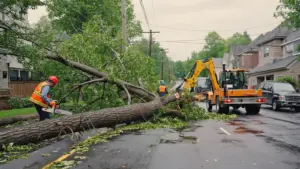
Emergency response draws on the same equipment as any large removal, just compressed into far less notice: a bucket truck or crane-assisted removal for a storm-damaged tree too tall or tangled for a simple drop-cut, rigging in place of a straightforward felling cut near a structure, and a stump grinder or wood chipper once the hazard itself is down. Crews still work under ANSI Z133 safety rules and OSHA equipment standards at 2 a.m. the same as at 2 p.m., and most municipalities waive a city tree permit or heritage tree ordinance for a genuine life-safety removal, though those rules can still apply to non-emergency follow-up work on a neighboring oak or pine.
How we built this guide
We built this guide from published pricing data across major cost-estimating platforms, utility safety guidance, and a state consumer-protection office’s storm-fraud advisory. This guide cites 6 sources, , reviewed by the CompareTreeServices editorial team. Response times and pricing shift with storm activity and local crew availability, so treat every figure here as a planning range, not a quote.
What to expect from an emergency tree service comes down to triage first, price second: confirm it’s a genuine emergency, call the utility if a line is involved, and get a certificate of insurance before anyone starts cutting, storm or no storm.
Sources
- [S1] How Much Does Tree Removal Cost? (2026), HomeGuide
- [S2] Tree Removal Cost (2026 Data), Angi
- [S3] How Much Does It Cost to Remove a Tree? (2025 Data), HomeAdvisor
- [S4] Downed Power Lines, FirstEnergy
- [S5] How Much Does Tree Removal Cost? (2026 Pricing), This Old House
- [S6] Storms and Fraud, Georgia Attorney General’s Consumer Protection Division
About this guide
Researched and maintained by the CompareTreeServices editorial team, alongside the public Google Business data behind our tracked directory. How the numbers are built: methodology · listing standards.