
No Guesswork: How Long Does Tree Removal Take? By Size and Access
Short answer: A small to medium tree in an open yard usually comes down in 2 to 4 hours [S1]. Large trees, tight access, or anything needing a crane can push the job to a full day or longer, since crane staging and sectional rigging both add real time before the first cut happens [S2].
The CompareTreeServices Take
Our position is boring and it works: verify insurance yourself, get scope in writing, and compare crews on demonstrated review volume rather than the loudest ad.
| Tree size or condition | Typical time on site | What extends it |
|---|---|---|
| Small to medium, open access | Often 2 to 4 hours | Multiple trees on the same lot |
| Large (60 to 80 ft) | Half a day to a full day | Rigging time, canopy spread, nearby structures |
| Very large (80 ft+) or hard access | A full day, sometimes multi-day | Crane staging and rental, sectional lowering |
| Storm-damaged or leaning, any size | Longer than a routine job | Extra hazard assessment before any cut starts |
Sources for this table: S1, S2 in the Sources list below.
Table of Contents
What actually happens during a crew day
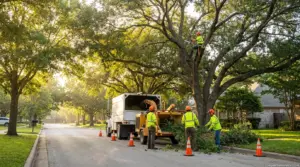
A removal isn’t one long cut, it’s a sequence. The crew assesses the tree and the drop zone, clears the work area, and removes lower and mid-canopy branches first to reduce weight and improve visibility before the trunk comes down [S1]. Heavier limbs get lowered with ropes instead of dropped, especially near a structure, fence, or another tree. Once the trunk is down, the crew sections it, runs the brush through a wood chipper, and either grinds the stump or leaves it for a separate visit [S1].
Cutting itself often takes less time than everything around it. Hauling wood, feeding a chipper, and cleaning up debris regularly account for as much of the job as the tree work itself, which is part of why a “quick” removal can still run half a day.
Why size and access change the math
Height and trunk diameter (DBH, diameter at breast height) set the baseline; a wider trunk means more cuts and more wood to move regardless of height. Access changes the math on top of that. A tree with a clear, open drop zone lets a crew fell it in fewer, larger sections. A tree wedged near a roofline, fence, or power line forces rigging or drop-cutting instead, lowering each piece by rope, which is slower and safer than a straight drop but adds real hours [S2].
Once a tree tops roughly 80 feet or has no safe fall path, crews bring in a crane, and that changes the entire day: staging the crane, rigging each section for a controlled lift, and coordinating ground crew all add time before cutting even starts [S2]. See our large tree removal guide for what that logistics picture looks like in full.
Multiple trees, stump grinding, and other add-ons
Clearing several trees at once is rarely a simple multiple of a single tree’s time, since crews can stage equipment once and work through the lot, but a bigger job still means a longer day or a second visit. Stump grinding is frequently scheduled separately from the removal itself; grinding several stumps in one visit is faster per stump than one-off jobs [S3]. If you’re weighing whether to grind now or later, our stump grinding vs. removal guide breaks down that decision.
Species matters less for time than density and branch structure. LawnStarter’s national data puts average removal cost at roughly $10 to $14 per foot of height, and the same factors driving that number, height, canopy, and wood density, drive the time on site too [S3]. See our tree removal cost guide for the full size-based pricing breakdown.
What’s safe to do yourself, and when to call a pro
Watching the crew, keeping kids and pets clear of the drop zone, and asking questions about the day’s plan are all fine to do yourself. Anything involving a chainsaw, rigging, or a climb is not: a removal large enough to need a full crew day is also large enough that a bad cut or an unexpected barber-chair split can seriously hurt someone. That part of the job belongs to an ISA Certified Arborist and an insured crew working to the ANSI Z133 safety standard, not a homeowner with a weekend to spare.
A crew that gives you a realistic time estimate upfront, not just a price, is usually a good sign they’ve actually scoped the job. See our guide to choosing a tree service for what else separates a careful crew from a rushed one.
Every pro in our directory has cleared our listing checks checklist, including proof of insurance, before a single estimate goes out.
Key takeaways
- A standard small to medium tree removal typically takes 2 to 4 hours on site [S1].
- Large trees, tight access, or crane-required jobs can stretch a removal to a full day or longer [S2].
- Cutting is often the fastest part; hauling, chipping, and cleanup frequently take just as long.
- Multiple trees on one property usually finish faster per tree than scheduling separate visits.
- A crew quoting a realistic timeline, not just a price, is a good early signal of how carefully they’ve scoped the job.
Frequently asked questions
How long does it take to cut down a small tree?
A small tree in an open yard, clear of structures and power lines, is often a 2-to-4-hour job including cleanup [S1]. Multiple small trees on the same property usually add time, but less per tree than scheduling them separately.
How long does removing a large tree take?
A large tree, 60 to 80 feet or more, commonly takes a half day to a full day, and can run longer if a crane or extensive rigging is needed to protect a nearby structure [S2]. Our large tree removal guide covers the logistics behind that timeline.
Does tree removal always finish in one day?
Most residential jobs do. Multiple trees, a very large tree, poor access, or a crane requirement are the main reasons a removal stretches past a single day [S2]. A standing quote should tell you upfront if your job is likely to take more than one visit.
What takes longer, cutting the tree or cleaning up?
Often cleanup. The actual felling and sectioning can be the shorter half of the job; hauling wood, running brush through a chipper, and clearing debris regularly take just as long or longer [S1]. That’s part of why a small tree can still eat half a day.
Does stump grinding add much time to the job?
It depends on scheduling. Some crews grind the stump the same day; others schedule it separately, especially if grinding several stumps at once is more efficient than a one-off visit [S3]. Ask upfront whether your quote includes same-day grinding.
Why does access matter so much to the timeline?
A tree with a clear, open fall path lets a crew work in large sections. One wedged near a fence, roofline, or power line requires rigging or drop-cutting instead, lowering each piece by rope, which is safer but slower than a straight drop [S2]. Tight access is one of the most common reasons a quote’s time estimate runs long.
Whatever the species, oak, pine, maple, or a fast-growing poplar, the clock is set far more by trunk diameter, canopy spread, and access than by what kind of tree it is. A wide, dense trunk takes longer to section than a tall, narrow one even at the same height, and a tree with a bucket truck’s reach and an open drop zone moves faster than one needing a crane and hand-rigged lowering line by line.
How we built this guide
We built this guide from published tree-care process descriptions and national pricing data, cross-checked against each other rather than taken from a single source. This guide cites 3 sources, , reviewed by the CompareTreeServices editorial team. Actual time on site always depends on your specific tree and crew, so treat these ranges as planning estimates, not a guarantee.
So how long does it take to remove a tree at your address? Plan on a few hours for anything small and open, and a full day once size, access, or a crane enters the picture. Ask your quote for a time estimate, not just a price, and you’ll know which one you’re getting.
Related reading: How Close Can a Tree Be to a House? Safe Distance Guide.
Sources
- [S1] How To Take Down a Dead Tree, This Old House
- [S2] How To Remove a Tree From Your Yard, Angi
- [S3] Pricing Guide: How Much Does Tree Removal Cost?, LawnStarter
About this guide
Researched and maintained by the CompareTreeServices editorial team, alongside the public Google Business data behind our tracked directory. How the numbers are built: methodology · listing standards.