
A 2026 Reality Check: Tree Removal Near Power Lines
Short answer: If a tree or branch is touching, near, or leaning toward a power line, call your utility company first. Federal safety rules bar anyone without specialized line-clearance training from working within 10 feet of an energized line carrying up to 50,000 volts [S1]. Electrocution is the single leading cause of death among tree workers, which is exactly why this job is never DIY [S2].
The CompareTreeServices Take
Our position is boring and it works: verify insurance yourself, get scope in writing, and compare crews on demonstrated review volume rather than the loudest ad.
| Situation | Who handles it | Why |
|---|---|---|
| Branch touching or arcing near a power line | Utility company | Requires a qualified line-clearance tree trimmer under federal rules |
| Tree limb near main lines, inside a utility easement | Utility company | Utilities maintain clearance on their own easements and rights-of-way |
| Branches near the low-voltage service drop to your house | Utility or an insured pro | Even a “low-voltage” line carries lethal current; treat it the same way |
| Digging near roots for stump work or planting | You, after calling 811 | Root growth can shift a buried line’s depth over time |
Sources for this table: S1, S3, S2, S4 in the Sources list below.
Table of Contents
Who’s responsible: the utility or you
Utilities generally own the responsibility for clearance on the main lines running along the street and through their easements, including any tree or limb actively touching those lines [S3]. Homeowners are typically responsible for trees clear of the main system, and for cleanup after a storm or emergency repair, but that responsibility never extends to cutting anything near an energized conductor yourself [S3].
The line most people miss: the service drop connecting the street to your house is often still the utility’s territory too, or at minimum still requires the same caution as the main line. When in doubt, the call goes to the utility, not to your own ladder.
Why this is never a DIY job
Federal workplace safety rules set a minimum approach distance of 10 feet for any power line at 50,000 volts or below, adding 4 inches of clearance for every additional 10,000 volts. Only a trained line-clearance tree trimmer, working with insulated tools, may work inside that distance, and even then a second trained worker has to stay within voice range [S1]. That standard exists because the consequences are not hypothetical: NIOSH tracked 181 tree-trimming deaths over one eight-year study period, and electrocution caused 68 of them, more than any other single cause, ahead of falls [S2].
A homeowner with a pole saw has none of the training, insulated equipment, or voltage-testing knowledge that standard assumes. Treat every line as energized and every branch touching one as a hazard, not a chore.
The 811 step everyone skips
Digging near a tree, whether you’re grinding a stump, planting a replacement, or trenching for irrigation, means calling 811 first, every time, not just once. Buried lines don’t always stay where they were installed: root growth and soil erosion can shift a line’s effective depth over the years, which is why the national call-before-you-dig service asks for a fresh locate on every project, even ground you’ve dug before [S4]. It’s free, it typically takes a few business days to get lines marked, and skipping it risks a utility strike, an outage, and a legal violation, not just a fine.
This applies even for tree work nowhere near an overhead line. Overhead and underground are two separate hazards, and this job can involve both.
What actually happens when you call it in
Most utilities take reports of a tree touching or threatening a line seriously and treat it as a priority dispatch, clearing the hazard themselves when it sits inside their own vegetation-management easement, though cleanup of the resulting debris and wood is typically the property owner’s responsibility, not the utility’s [S3]. Expect a crew to assess the situation, potentially deenergize the line temporarily, and clear the branch with insulated tools or a bucket truck. If the tree itself needs to come down and it’s outside the utility’s territory, that’s when you bring in your own insured crew, ideally one with line-clearance-trained climbers on staff; see our tree removal cost guide for what that job typically runs. See our hazardous tree removal guide if the tree is leaning or damaged on top of being close to the line.
What’s safe to do yourself, and what absolutely isn’t
There is no safe cutting tier here. Reporting the hazard to your utility, taking photos from a safe distance, and keeping people and pets away from the area are the only DIY-safe actions on this page. Trimming, cutting, or even leaning a ladder near a line you haven’t confirmed is de-energized isn’t a judgment call, it’s the highest-fatality mistake in this entire trade [S2]. That holds even for a small branch, since a “small” job next to 7,200 volts isn’t small at all.
Hire only a company that can show a certificate of insurance and confirms its climbers carry line-clearance training, not just general tree experience. See our guide to choosing a tree service for the exact questions to ask before anyone touches a ladder.
Every pro in our directory has already cleared our listing checks checklist, including proof of insurance, before we list them.
Key takeaways
- Tree removal near power lines is never a homeowner job, regardless of the branch’s size [S1][S2].
- Federal rules require a 10-foot minimum approach distance from lines up to 50,000 volts for anyone without line-clearance training [S1].
- Electrocution is the leading cause of death among tree workers, ahead of falls [S2].
- Utilities typically clear limbs touching their own lines and easements themselves, though debris cleanup afterward is usually on you [S3].
- Call 811 before any digging near a tree, even ground you’ve dug before; buried line depth can shift over time [S4].
Frequently asked questions
Who is responsible for a tree branch touching a power line?
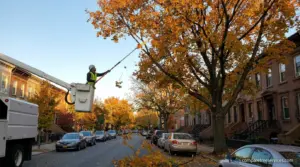
The utility company, in almost every case. Utilities maintain clearance on their main lines and easements and typically dispatch a crew once a branch is reported as touching or arcing near a line [S3]. Report it directly to your utility rather than attempting to clear it yourself.
Can I trim a tree branch myself if it’s just near a power line, not touching it?
No. Federal safety rules require a 10-foot minimum approach distance from any line up to 50,000 volts, enforced through specialized line-clearance training that a homeowner doesn’t have [S1]. “Near” a line is still inside the hazard zone; treat it exactly like a branch that’s already touching.
How dangerous is tree work near power lines, really?
Very. NIOSH found electrocution caused 68 of 181 recorded tree-trimming deaths in one multi-year study, the single leading cause, ahead of falls at 52 [S2]. That data covers trained professionals with equipment; an untrained homeowner faces the same hazard with none of the safeguards.
Do I need to call 811 even if I’m not digging near power lines?
Yes, if you’re digging at all. Planting a tree, grinding a stump, or trenching near roots all require an 811 call first, since buried utility lines aren’t always where records suggest, and root growth can shift their depth over time [S4]. Call before every project, not just the first one on a property.
Will the utility company remove a hazardous tree for free?
Often, yes, if the tree or limb is inside their easement or actively threatens their lines [S3]. Trees outside that zone are the property owner’s responsibility, which means hiring your own insured crew; see our tree removal permits guide if the tree is also large enough to need a permit.
What should I do if a tree falls on a power line during a storm?
Stay back, keep others away, and call 911 and your utility immediately; treat every downed line as energized whether or not it looks that way. Don’t attempt any cleanup near the line yourself. Our storm damage tree cleanup guide covers the full sequence once the utility clears the electrical hazard.
Line-clearance work sits at the intersection of two separate licensing worlds, arboriculture and electrical safety, which is why a general contractor’s insurance or a homeowner’s confidence with a chainsaw doesn’t cover it. A qualified line-clearance tree trimmer works under the same voltage-awareness rules as a utility lineman, carries insulated tools rated for the job, and coordinates directly with the utility before any cut happens near an energized conductor, whether the tree in question is an oak, a pine, or a fast-growing poplar planted too close to the easement decades ago.
How we built this guide
We sourced this guide from federal workplace safety standards, a federal occupational health fatality study, a major utility’s published homeowner guidance, and the national 811 call-before-you-dig service, not general contractor blogs. This guide cites 4 sources, , reviewed by the CompareTreeServices editorial team. Utility-specific policies vary. Call your own utility to confirm their process and timeline.
Tree removal near power lines comes down to one rule that never changes: if a line is involved, the call goes out before the chainsaw comes out, every time, no exceptions for how small the branch looks from the ground.
Sources
- [S1] Line-Clearance Tree Trimming Operations, Occupational Safety and Health Administration
- [S2] NIOSH Alert: Preventing Falls and Electrocutions During Tree Trimming, CDC/NIOSH
- [S3] Homeowner Rights and Responsibilities, FirstEnergy
- [S4] Before You Dig, 811
About this guide
Researched and maintained by the CompareTreeServices editorial team, alongside the public Google Business data behind our tracked directory. How the numbers are built: methodology · listing standards.