
A 2026 Reality Check: Tree Removal Quote
Short answer: A complete tree removal quote covers the tree itself, debris hauling or chipping, and states clearly whether stump grinding and permit fees are included or separate. Get at least two quotes from crews who walk the property in person, not just a phone estimate, and treat cash-only, no-paperwork bids as a hard pass.
The CompareTreeServices Take
The expensive mistake in tree work is almost never the hire, it is the wait. Trees fail on their own schedule; the homeowners who do well decide early, with a ranked shortlist already in hand.
| Line item | What it actually covers |
|---|---|
| Tree removal | Cutting and dropping the tree, priced by height or trunk diameter (DBH) |
| Hauling / debris removal | Trucking cut wood and brush off your property |
| Wood chipping | Running brush through a chipper on-site instead of hauling whole logs |
| Stump grinding | Grinding the stump below grade, almost always a separate line item |
| Permit fee | Set by your city, passed through if your tree needs one |
| Emergency / after-hours premium | Added charge for same-day or overnight dispatch |
Table of Contents
Getting more than one tree removal quote
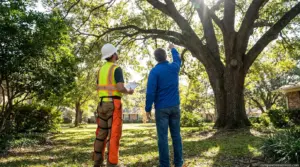
Get at least two, ideally three, quotes before you sign anything, and push for an in-person walkthrough rather than a number quoted over the phone from a photo; a crew that hasn’t walked the site can’t accurately judge access, overhead lines, or how the tree needs to come down. Purdue University Extension’s arborist-hiring guidance backs the fundamentals here: get more than one estimate, ask for proof of insurance, and get the estimate in writing before you sign [S1].
A written quote also protects you later. Verbal promises about hauling everything away or including the stump tend to disappear once the invoice shows up; a line-itemized, signed estimate does not.
What the line items actually mean
Removal itself is usually priced by height or by trunk diameter at breast height (DBH), and a fair quote should say which one it’s using and specify the exact tree, not “trees on the property.” Hauling and chipping are frequently separate charges even when they sound like part of the same job; ask directly whether the quote includes getting the wood off your property or just dropping it in your yard.
Stump grinding is nearly always its own line item, priced separately from the tree removal itself. LawnStarter puts stump grinding at $2 to $5 per inch of stump diameter [S5]. See the stump grinding cost guide for the full breakdown, or the tree removal cost guide for what the removal itself typically runs.
Permit fees, where your city requires one for a large or protected tree, should show up as a pass-through cost, not a padded markup. Emergency or after-hours dispatch is its own premium too: This Old House notes urgent, same-day tree removal can run as high as $5,000 in genuinely time-sensitive cases, well above a scheduled job [S6]. If your tree isn’t actively threatening anything, a standard appointment usually costs less than rushed service.
Why quotes vary so much between companies
The same tree can generate wildly different numbers from different crews, and it’s rarely random. Access drives a lot of it: a tree with a clear drop zone costs less to remove than one wedged near a fence, a shed, or power lines, since tight jobs need rigging instead of a straight drop-cut. Crew size, equipment on hand (a bucket truck or crane versus climbing gear), and how busy a company is that month all move the number too.
Insurance overhead is the quiet factor most homeowners miss. A company carrying real general liability and workers’ comp prices that cost into every job; an uninsured outfit that skips it can look cheaper on paper while leaving you exposed if someone gets hurt on your property.
Red flags in a tree removal quote
Some warning signs show up on the quote itself, before a saw ever starts. A bid dramatically lower than every other one you got is the most common trap: low upfront, then a string of “surprise” add-ons once the crew is already on-site and you feel stuck. Cash-only pricing, no written estimate, or pressure to sign “today only” are all reasons to walk.
Door-to-door solicitation right after a storm deserves extra scrutiny. NAIC (the National Association of Insurance Commissioners) warns homeowners to beware of contractors going door-to-door after a storm, and to call the insurer directly to verify any coverage a bidder claims to carry [S2]. A legitimate company doesn’t need to canvass your street the day after a hurricane to find work.
Verifying insurance and credentials before you sign
Ask every bidder for a certificate of insurance (COI) showing active general liability and workers’ comp, and confirm it directly with the insurer rather than trusting a photocopy, exactly what NAIC recommends for any storm-related contractor [S2]. Then ask whether an ISA Certified Arborist will actually be on site, not just listed on the company website; see ISA Certified Arborist: what the credential requires for how to check that credential yourself. ISA’s own arborist-finder guidance is built around that same verification step: confirming a credential independently rather than taking a company’s word for it [S3].
TCIA-Accredited companies must carry insurance and keep the required number of Certified Arborists on staff to maintain that accreditation, which is a reasonable floor to hold any bidder to [S4]. Every pro in our directory has already cleared our listing checks checklist, so the quotes you’re comparing start from a baseline of real insurance and real credentials.
Key takeaways
- Get at least two quotes from crews who walk the property in person; a phone-only estimate is a guess, not a real number [S1].
- A complete quote states clearly whether hauling, chipping, stump grinding, and permit fees are included or billed separately.
- A dramatically low bid is a red flag, not a deal: it usually signals costly add-ons once work starts, not real savings passed on to you.
- Always ask for a certificate of insurance and confirm it directly with the insurer before you sign [S2].
- Storm-chasing, door-to-door contractors after major weather events deserve extra scrutiny, not an easy yes [S2].
Frequently asked questions
What should be included in a tree removal quote?
A complete quote should name the specific tree, state the pricing basis (height or trunk diameter), and say clearly whether hauling, chipping, stump grinding, and any permit fee are included or billed separately. Get it in writing, not just a verbal number.
How many tree removal quotes should I get?
At least two, ideally three, and insist on an in-person walkthrough rather than a phone estimate, since a crew that hasn’t seen the site can’t accurately judge access or how the tree needs to come down. Purdue University Extension’s guidance backs the multiple-estimate step directly [S1].
Why do tree removal quotes vary so much between companies?
Access, crew size, equipment, and insurance overhead all move the number. A tree with a clear drop zone costs less than one needing rigging near a structure or power line, and an insured company prices that liability into every job.
Is the cheapest tree removal quote usually the best one?
Not reliably. A bid well below every other quote often means costly surprises once work starts, unlicensed or uninsured labor, or a crew that cuts corners on cleanup and disposal. Compare scope, not just price.
How do I know if a tree removal company’s insurance is real?
Ask for a certificate of insurance and call the insurer directly to confirm it’s active, rather than trusting a photocopy or a verbal claim [S2]. TCIA-Accredited companies are required to maintain both liability coverage and workers’ comp [S4].
Should I be worried about a company that shows up after a storm?
Yes, extra scrutiny is warranted. Storm-chasing contractors who canvass neighborhoods right after severe weather are a documented pattern, and they’re frequently unlicensed or uninsured [S2]. Get the same written quote and insurance verification you’d require from any other bidder.
A solid quote reads like a job description, not a guess: it names the tree, states DBH or height as the pricing basis, and spells out whether rigging, drop-cutting, or a crane-assisted removal is needed for access. It lists a certificate of insurance covering general liability and workers’ comp, notes any city tree permit or heritage ordinance requirement, and separates stump grinding, wood chipper hauling, and any minimum call-out fee from the removal price itself. If oak, pine, or another dense species changes the labor involved, a fair quote says so instead of burying it. Anything vague on those points is a quote worth questioning before you sign.
How we built this guide
Guidance on getting and comparing bids comes from university extension research and consumer-protection sources; cost figures are cross-checked against published pricing studies. This guide cites 6 sources, , reviewed by the CompareTreeServices editorial team.
A tree removal quote is only useful if you can actually read it. Get more than one, insist on a walkthrough and a written scope, and verify insurance directly before anyone touches a chainsaw on your property.
Sources
- [S1] Purdue University Extension, “Why Hire an Arborist?”
- [S2] National Association of Insurance Commissioners, “How Can I Avoid Getting Scammed by a Contractor?”
- [S3] International Society of Arboriculture, “Find an ISA-Credentialed Arborist”
- [S4] Tree Care Industry Association, “TCIA Accreditation”
- [S5] LawnStarter, “How Much Does Stump Grinding Cost?”
- [S6] This Old House, “How Much Does Tree Removal Cost in 2026?”
About this guide
Researched and maintained by the CompareTreeServices editorial team, alongside the public Google Business data behind our tracked directory. How the numbers are built: methodology · listing standards.