
A 2026 Reality Check: Best Time of Year for Tree Removal (and to Save Money)
Short answer: Late fall through winter is generally the best time to remove a tree: demand drops, some crews offer off-season pricing, and dormant surrounding vegetation is less likely to be damaged during the work. An emergency removal, storm damage or a tree threatening a structure, doesn’t wait for the ideal season, and shouldn’t.
The CompareTreeServices Take
The expensive mistake in tree work is almost never the hire, it is the wait. Trees fail on their own schedule; the homeowners who do well decide early, with a ranked shortlist already in hand.
| Season | Removal timing | Why |
|---|---|---|
| Late fall to winter | Best for scheduled, non-urgent removal | Lower demand, firmer ground, dormant surrounding plants |
| Spring | Busiest season, higher demand | Storm cleanup backlog and general yard-work season drive up bookings |
| Summer | Busy, heat can slow crews | Peak storm season in many regions adds emergency jobs to the queue |
| Any season | Right time for an emergency removal | A hazardous or storm-damaged tree can’t wait for dormant season |
Sources for this table: S1 in the Sources list below.
Table of Contents
Why demand and pricing shift by season
Tree companies see their heaviest demand in spring and summer, driven by storm cleanup, general landscaping projects, and homeowners tackling yard work while the weather’s good [S1]. That demand curve is exactly why late fall and winter tend to run the other direction: crews have more open schedule slots, and some companies price accordingly to keep work flowing through their slower months.
This isn’t universal or guaranteed. Regional storm patterns matter, since a region that gets hit hard by winter ice storms sees its own seasonal spike then instead. The general pattern still holds in most of the country: ask directly whether a company offers off-season scheduling, since it’s a real lever but not an advertised one everywhere.
Regional storm calendars shift the picture further. Gulf Coast and Southeast markets run on their own demand curve tied to hurricane season, roughly June through November, when storm-damaged trees push emergency work ahead of anything scheduled and pricing follows the storm, not the month [S4]. Angi’s national pricing data puts the broader seasonal swing at 10 to 20 percent higher in summer and fall versus the slower winter and early-spring window, which tracks with the late-fall-through-winter recommendation above even outside hurricane-prone regions [S4].
Why dormant-season removal is easier on the yard
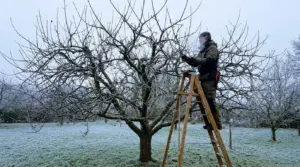
Removing a tree isn’t a clean, isolated event; a crew working near other trees, shrubs, and lawn risks some collateral damage just from equipment movement and falling debris. During the dormant season, most surrounding plants aren’t actively growing, which means less risk of stressing nearby trees’ root systems from heavy equipment compaction, and less risk of damaging visible new growth on shrubs and perennials near the work zone.
Ground conditions matter too. Frozen or firm winter ground supports heavy equipment, like a bucket truck or a crane for a large job, better than soft, saturated spring soil, which can rut a lawn or compact soil around nearby root systems.
When timing doesn’t apply
None of this seasonal logic applies to an emergency. A tree that’s already fallen, leaning dangerously after a storm, or actively threatening a house or power line needs removal now, not whenever the calendar is most convenient. See our emergency tree removal cost guide for what urgent, after-hours work typically costs; it runs higher than a scheduled job precisely because timing isn’t optional in those cases.
A confirmed dead tree with no immediate target nearby is the middle case: not an emergency, but also not something to let drag on indefinitely, since dead wood only gets more unpredictable over time. That’s a reasonable candidate for scheduling into the next dormant-season window if it’s genuinely stable in the meantime.
Getting the best price regardless of season
Timing helps, but it’s one lever among several. Getting quotes from two or three companies matters more than season alone, since prices for the same tree can vary widely between crews regardless of month. Bundling stump grinding into the same visit, rather than scheduling it separately, is another straightforward way to save that has nothing to do with the calendar. Our tree removal cost guide covers the full range of factors that move price, season being just one of them.
Key takeaways
- Late fall through winter is generally the best time to remove a tree for both pricing and yard impact.
- Spring and summer see the highest demand, driven by storm cleanup and general yard-work season.
- Dormant-season removal reduces risk to nearby plants and often allows firmer equipment access.
- An emergency removal, storm damage or an immediate hazard, should never wait for the ideal season.
- Getting multiple quotes and bundling stump grinding save money regardless of when you schedule.
Frequently asked questions
What is the best time of year to remove a tree?
Late fall through winter, when demand is generally lower, surrounding plants are dormant, and ground conditions often support equipment better [S1]. Regional storm patterns can shift this somewhat, so ask a local crew about their own slow season.
Is tree removal cheaper in the winter?
Often, yes, though it’s not universal. Lower off-season demand gives some companies room to offer better scheduling flexibility or pricing, but it’s worth asking directly rather than assuming a discount applies everywhere [S1].
Can you remove a tree in any season?
Yes, removal itself isn’t seasonally restricted the way some pruning is. The seasonal advantage is about cost, crew availability, and reduced risk to nearby plants, not a hard technical requirement.
Does winter tree removal damage the lawn less?
Generally yes, since dormant grass and firmer or frozen ground handle heavy equipment better than soft, actively growing spring turf. Wet spring conditions are more likely to leave ruts or compact soil around nearby root systems.
Should I wait for the best season if a tree looks hazardous?
No. A tree that’s leaning dangerously, has visible cracking, or threatens a structure needs an assessment and likely removal now, not on a seasonal schedule. See our tree risk assessment guide for how to evaluate urgency, and our emergency tree removal cost guide for what urgent work costs.
What’s the fastest way to save money on tree removal regardless of season?
Get quotes from two or three companies and bundle stump grinding into the same visit instead of scheduling it separately [S2]. Both moves save real money independent of what time of year you book the job.
Whatever the season, a fair quote should reference DBH (diameter at breast height) for pricing and confirm the crew’s certificate of insurance covering general liability and workers’ comp before any climber goes up; a winter job near a structure still uses rigging or a crane-assisted removal the same way a summer one would, and ANSI Z133 safety rules don’t change with the calendar [S3].
How we built this guide
Seasonal demand patterns are sourced from published tree-service cost research; ground-condition and dormancy reasoning reflects standard arboriculture practice. This guide cites 4 sources, , reviewed by the CompareTreeServices editorial team.
The best time to remove a tree, when you have the luxury of choosing, is late fall through winter: lower demand, steadier ground, and dormant surrounding plants all favor that window. When a tree is genuinely hazardous, though, the right season is now.
Related reading: Ash Tree Removal Cost in 2026: EAB and What You’ll Pay.
Related reading: How Long Does Tree Removal Take? By Size and Access.
Sources
- [S1] Pricing Guide: How Much Does Tree Removal Cost?, LawnStarter
- [S2] How Much Does Stump Grinding Cost?, LawnStarter
- [S3] Tree Risk Assessment Qualification, International Society of Arboriculture
- [S4] [Tree Removal Cost [2026 Data], Angi](https://www.angi.com/articles/how-much-does-tree-removal-cost.htm)
About this guide
Researched and maintained by the CompareTreeServices editorial team, alongside the public Google Business data behind our tracked directory. How the numbers are built: methodology · listing standards.