
The 2026 Shortlist: Best Trees for Clay Soil
Key stat: Fifteen of our thirty highest-demand tracked metros sit in classic red-clay or blackland-prairie states: Texas, Georgia, North and South Carolina, Alabama, Tennessee, and Oklahoma (see our methodology). Clay soil isn’t a rare edge case for a big share of the country; it’s the baseline homeowners are actually planting into.
The CompareTreeServices Take
The expensive mistake in tree work is almost never the hire, it is the wait. Trees fail on their own schedule; the homeowners who do well decide early, with a ranked shortlist already in hand.
| Species | Mature height | Growth rate | Clay / mess risk | USDA zones |
|---|---|---|---|---|
| Bald cypress | 50-70 ft | Medium | Clay-tolerant, handles standing water; chlorosis risk in alkaline soil | 4a-9b |
| Swamp white oak | 50-60 ft | Medium | Clay-tolerant, handles spring flooding | 4a-8b |
| Willow oak | 40-75 ft | Fast | Adaptable to clay soils; susceptible to wind damage | 5a-9b |
| River birch | 30-70 ft | Rapid | Tolerates clay and flooded conditions; drops twigs and leaves in drought | 4a-9b |
| Red maple | 40-120 ft | Rapid | Shallow roots buckle pavement; wind and ice break some branches | 2a-9b |
| Eastern redbud | 20-30 ft | Medium | Tolerates moderately fertile clay soil; short-lived, under 75 years | 4a-9b |
Sources for this table: S1, S2, S3, S4, S5, S6 in the Sources list below.
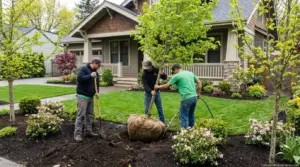
Our take: Stop trying to fix clay soil at the planting hole; it doesn’t work, and the guidance on this is unambiguous: “Always use the original (native) soil as backfill. You should not add any amendments to the backfill” [S7]. The actual fix is choosing a species that already tolerates clay, bald cypress, swamp white oak, willow oak, and the others in this matrix, instead of spending money on soil amendments that create a bathtub around the root ball.
Table of Contents
The two built for standing water
Bald cypress and swamp white oak both handle the wettest version of clay soil, the low spot that holds water for days after rain. Bald cypress has been documented to “tolerate flooded conditions for extended periods of time” and adapts across everything from somewhat dry soils to standing water [S1]. Swamp white oak carries a similar profile, specifically noted as tolerant of areas with spring flooding [S2]. Between the two, bald cypress is the better fit for genuinely low, wet ground, while swamp white oak works well on clay that’s wet in spring and dries out later in the season.
The three for typical clay, not standing water
Willow oak, river birch, and red maple all handle ordinary clay without a low spot or standing-water problem. Willow oak is specifically documented as “adaptable to a variety of soil types including clay soils” while transplanting well thanks to a fibrous root system [S3]. River birch shares that clay tolerance while adding genuine wet-soil range beyond it [S4], though its litter habit, dropped twigs and interior leaves during drought, is a real maintenance tradeoff worth planning around, especially near a house or gutters. Red maple tolerates clay reasonably well too, though its shallow, mat-forming root system is worth keeping clear of driveways and sidewalks regardless of soil type [S5].
Eastern redbud for a smaller clay-tolerant option
Not every clay lot needs a full shade tree. Eastern redbud specifically tolerates “moderately fertile clay or sandy soil” at a much smaller mature size, 20-30 feet, with low overall maintenance beyond occasional dead-branch pruning [S6]. Its real limitation is longevity rather than soil performance, since it’s genuinely short-lived compared to the oaks and cypress in this matrix.
What we recommend
Match the tree to how wet the clay actually gets. On a low spot that ponds after rain, bald cypress is the most flood-tolerant option here and wants little beyond neutral-to-acidic soil. On ordinary clay that drains eventually, willow oak establishes fastest, with river birch as the wetter-tolerant fallback where its litter won’t be a nuisance near the house. If raw growth speed is the priority and drainage is only a secondary worry, our best fast-growing shade trees guide ranks these same species by wood strength instead. One rule holds under every pick: backfill with the native clay you dug out, never a sand-or-compost mix that turns the planting hole into a bathtub.
Key takeaways
- Amending a clay planting hole with sand or compost can trap water around the roots instead of helping drainage.
- Bald cypress and swamp white oak both genuinely tolerate standing water on heavy clay.
- Willow oak transplants reliably in clay thanks to its fibrous root system.
- River birch tolerates clay well but drops twigs and interior leaves, a real maintenance tradeoff.
- Eastern redbud is the smaller-scale clay-tolerant option, though shorter-lived than the oaks or cypress.
Frequently asked questions
What trees grow best in heavy clay soil?
Bald cypress and swamp white oak handle the wettest clay conditions, including standing water and spring flooding [S1][S2]. Willow oak and river birch both tolerate ordinary clay well while establishing faster [S3][S4].
Should I amend clay soil before planting a tree?
No, according to extension guidance. Amending the backfill creates a “bathtub effect” where water collects around the roots instead of draining into the surrounding clay, and adding sand specifically can make clay denser, not looser [S7]. Backfill with the native soil instead.
Do all trees struggle in clay soil?
No, several species are specifically documented as clay-tolerant, including bald cypress, swamp white oak, willow oak, river birch, red maple, and Eastern redbud [S1][S2][S3][S4][S5][S6]. Picking one of these avoids fighting the soil at all.
Is red maple a good tree for clay soil?
Reasonably, yes, though its shallow, mat-forming root system is worth keeping clear of driveways and sidewalks regardless of soil type [S5]. Willow oak or swamp white oak are stronger picks if root-related pavement damage is a concern.
What’s a smaller tree option for clay soil?
Eastern redbud tolerates moderately fertile clay soil at a compact 20-30-foot mature size, though it’s shorter-lived than the larger species in this matrix [S6].
How much does it cost to plant a tree in clay soil?
Planting cost depends on species and size, not soil type directly, though a clay site sometimes needs extra excavation time. See our tree planting cost guide for pricing, and our tree removal cost guide if an existing tree struggling in clay needs to come out.
How we built this guide
Every mature-size, growth-rate, and clay-tolerance claim here is drawn directly from university extension horticulture sources; nothing is estimated. This guide cites 6 sources, , reviewed by the CompareTreeServices editorial team.
There is no amendment recipe that beats a species built for the site. Bald cypress, swamp white oak, and the rest of this list thrive in clay for the plain reason that clay is where they already grow, and that answer costs a lot less than a truckload of sand that only makes the problem worse.
Related reading: Best Trees for Privacy: 5 Species Ranked (and 1 to Avoid).
Sources
- [S1] Taxodium distichum (Bald Cypress), NC State Extension Plant Toolbox
- [S2] Quercus bicolor (Swamp White Oak), NC State Extension Plant Toolbox
- [S3] Quercus phellos (Willow Oak), NC State Extension Plant Toolbox
- [S4] Betula nigra (River Birch), NC State Extension Plant Toolbox
- [S5] Acer rubrum (Red Maple), NC State Extension Plant Toolbox
- [S6] Cercis canadensis (Eastern Redbud), NC State Extension Plant Toolbox
- [S7] Mythbusters: Should You Amend Heavy Clay Soil Before Planting?, Virginia Cooperative Extension Master Gardeners of Prince William
About this guide
Researched and maintained by the CompareTreeServices editorial team, alongside the public Google Business data behind our tracked directory. How the numbers are built: methodology · listing standards.