
The Short, Honest Answer: Can You Cut Down a Joshua Tree? California Law Explained
Short answer: The Western Joshua Tree Conservation Act, passed in 2023, prohibits importing, exporting, taking, possessing, purchasing, or selling any western Joshua tree in California without a CDFW permit. Two permit types exist: a no-cost Hazard Management Permit for dead trees or genuine safety risks, and an Incidental Take Permit for larger development projects, which typically requires a mitigation fee [S1].
The CompareTreeServices Take
Our position is boring and it works: verify insurance yourself, get scope in writing, and compare crews on demonstrated review volume rather than the loudest ad.
| Question | What’s true | Why it matters |
|---|---|---|
| Is removal ever legal without a permit? | Almost never | The Act bans take, damage, or removal statewide without CDFW authorization |
| Hazard Management Permit | Covers dead trees or trees posing a real risk to structures/safety | No application fee or mitigation required |
| Incidental Take Permit | Covers development, housing, public works projects | Requires in-lieu mitigation fees, generally $150 to $2,500 |
| Who can also issue permits | Cities and counties, via agreement with CDFW | Applies to single-family homes, accessory structures, some public works |
Sources for this table: S1 in the Sources list below.
Table of Contents
The law: what changed in 2023
California enacted the Western Joshua Tree Conservation Act as part of a state budget trailer bill signed on July 10, 2023 [S1]. The law makes it illegal to “cut down, uproot, damage, or remove any Western Joshua tree without obtaining the necessary permits or approvals from the California Department of Fish and Wildlife.” More broadly, the Act bans “importation, export, take, possession, purchase, or sale of any western Joshua tree in California unless authorized by CDFW” [S1].
This isn’t limited to the Mojave National Preserve or public land. The protection applies statewide to the western Joshua tree (Yucca brevifolia), including trees standing on private residential property, which is the detail that surprises most homeowners searching this question in the first place.
The two permit paths
CDFW issues two main permit types under the Act [S1].
Hazard Management Permits cover situations where a tree is already dead, or where a living tree poses a genuine risk to a structure or to public health and safety. This permit type doesn’t require an application fee or mitigation payment, which makes it the realistic path for a homeowner dealing with a dead or clearly hazardous Joshua tree near a house.
Incidental Take Permits cover a broader category: renewable energy projects, housing developments, public works, and other qualifying construction that will unavoidably affect Joshua trees during the project. This permit type does require mitigation, typically paid as an in-lieu fee rather than through direct conservation work, with fees generally ranging from $150 to $1,000 at a reduced rate and $340 to $2,500 at the standard rate [S1]. Those fees fund the Western Joshua Tree Conservation Fund, used for acquiring and managing conservation land for the species.
Counties and cities can also enter agreements with CDFW to handle permitting directly for smaller-scale projects: single-family homes, accessory structures, and some public works, which can streamline the process for an individual homeowner compared to applying through the state directly [S1].
What this means if you have a Joshua tree on your property
If a Joshua tree on your property is dead, start with the Hazard Management Permit path; it’s the no-fee option built for exactly this situation. If the tree is alive and you want it removed for a construction project, a driveway, an addition, a solar installation, expect to need an Incidental Take Permit and budget for the mitigation fee.
What you should not do is cut, remove, or damage a western Joshua tree without going through CDFW or your local jurisdiction’s delegated process first, even on land you own outright. The statewide protection applies regardless of property lines, and unauthorized removal carries legal risk separate from any homeowner’s association or local ordinance that might also apply.
What removal costs once you’re permitted
Joshua tree removal itself isn’t priced much differently from any other desert tree of similar size once you clear the permit step: LawnStarter’s national tree removal average runs $10 to $14 per foot of height [S2], and HomeGuide’s national range for a standard removal runs $400 to $1,200 [S3]. A mature Joshua tree’s height and its branching, spine-covered form can push a quote toward the higher end of a size bracket, since crews handle the leaves and trunk fiber differently than typical hardwood. Get your permit paperwork sorted before requesting quotes; most legitimate crews will ask for it before scheduling a protected-species job.
Care for a living Joshua tree
Beyond the legal question, Joshua trees are slow-growing desert natives adapted to arid, well-drained soil and minimal supplemental water once established. Overwatering, poor drainage, and disturbing the shallow root zone during nearby construction are more likely to stress or kill a healthy Joshua tree than most pest or disease pressure. If a tree looks like it’s declining, a genuine assessment before assuming removal is even necessary can save you a permit application you didn’t need.
DIY vs. hiring a pro
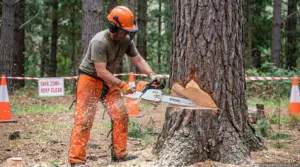
There’s no DIY path here that skips the legal question. Even a homeowner comfortable with a chainsaw needs a permit before cutting a western Joshua tree, dead or alive, so the first call should be to CDFW or your local planning department, not a tree crew. Once a permit is in hand, actual removal, especially of a large, spine-covered Joshua tree, is still safer handled by an experienced crew given the tree’s unusual growth form and the desert terrain most of these trees stand in.
Getting quotes from tracked pros
If you’ve confirmed you need a permit and secured one, or you’re dealing with a Hazard Management situation, ask a prospective crew whether they’ve handled protected-species removals before and whether they can help document compliance for your permit file. Confirm a certificate of insurance covering general liability and workers’ comp before anything else.
We’ve already run every pro in our directory through our listing standards, so you’re choosing between crews that already cleared that bar.
Key takeaways
- The Western Joshua Tree Conservation Act, effective 2023, bans cutting, damaging, or removing any western Joshua tree statewide without a CDFW permit [S1].
- A Hazard Management Permit, for dead or genuinely hazardous trees, requires no fee or mitigation [S1].
- An Incidental Take Permit, for development projects, requires mitigation, typically $150 to $2,500 in in-lieu fees [S1].
- Some cities and counties can issue permits directly for single-family homes and similar smaller projects [S1].
- The protection applies even on private property; property ownership does not exempt you from the permit requirement.
Frequently asked questions
Can you cut down a Joshua tree on your own property in California?
Not without a permit. The Western Joshua Tree Conservation Act prohibits cutting, damaging, or removing any western Joshua tree statewide, including on private land, without authorization from the California Department of Fish and Wildlife [S1].
What permit do I need to remove a dead Joshua tree?
A Hazard Management Permit, which covers dead trees and trees posing a real safety risk. It requires no application fee or mitigation payment, making it the realistic path for most homeowners dealing with a dead tree near a structure [S1].
Is there a fee to remove a living Joshua tree for a construction project?
Usually, yes. An Incidental Take Permit covers development-related removal, and it typically requires an in-lieu mitigation fee, generally $150 to $1,000 at a reduced rate or $340 to $2,500 at the standard rate [S1].
What happens if I cut down a Joshua tree without a permit?
The Act makes unauthorized take, damage, or removal illegal statewide, separate from any local ordinance. This guide covers the state permit framework; consult CDFW or a local attorney for enforcement specifics in your county.
Can my city handle the Joshua tree permit instead of the state?
In some cases. Certain cities and counties have entered agreements with CDFW to issue permits directly for single-family homes, accessory structures, and some public works projects, which can be faster than applying through the state [S1].
How do I know if my tree is a protected western Joshua tree?
The western Joshua tree (Yucca brevifolia) is the species covered by the Act. If you’re unsure whether a tree on your property qualifies, CDFW’s permitting resources and a local arborist familiar with desert species are the right first calls, before any cutting or trimming.
A crew or consultant handling a permitted Joshua tree removal typically documents the tree’s condition and location as part of the permit file, since CDFW review depends on that record. Any structural pruning that isn’t a full removal still falls under the same take-and-damage restrictions, so hazard trimming should also go through the Hazard Management Permit path rather than being treated as routine yard work.
How we built this guide
Legal requirements are sourced directly to the California Department of Fish and Wildlife’s program page for the Act. Cost framing draws on our own published pricing guides where relevant. This guide cites 3 sources, , reviewed by the CompareTreeServices editorial team. This page describes state-level requirements as of publication; permit rules and fees can change, so confirm current requirements with CDFW or your local jurisdiction before acting.
Can you cut down a Joshua tree in California? Only with a CDFW permit, whether that’s a no-cost Hazard Management Permit for a dead or hazardous tree, or a mitigation-fee Incidental Take Permit for a development project. Property ownership alone doesn’t authorize removal.
Related reading: Do I Need an Arborist or a Tree Service?.
Sources
- [S1] Western Joshua Tree Conservation Act, California Department of Fish and Wildlife
- [S2] Pricing Guide: How Much Does Tree Removal Cost?, LawnStarter
- [S3] How Much Does Tree Removal Cost? (2026), HomeGuide
About this guide
Researched and maintained by the CompareTreeServices editorial team, alongside the public Google Business data behind our tracked directory. How the numbers are built: methodology · listing standards.