
No Guesswork: How to Tell If a Tree Is Dangerous
The numbers behind this guide: Nationally, 18 percent of the tree service companies we track across 199 metros don’t maintain a website you could check before hiring them (see our methodology). For routine trimming that’s a minor inconvenience. For a tree you’ve already flagged as an active fall risk, it means you can’t verify insurance or credentials from a search before a crew shows up, so ask for a certificate of insurance in person and don’t assume it exists because the truck looks the part.
The CompareTreeServices Take
Our position is boring and it works: verify insurance yourself, get scope in writing, and compare crews on demonstrated review volume rather than the loudest ad.
| Hazard sign | What it signals | Action |
|---|---|---|
| Lean over 15% from vertical, new or increasing | Root or structural failure in progress | Professional risk assessment this week |
| Root plate lifting or cracked soil at the base | Roots pulling loose from the ground | Same-week assessment, treat as urgent |
| Large deadwood in the upper canopy (widowmakers) | Dead limbs can fall without warning | Removal of deadwood on a scheduled basis |
| Codominant stems with included bark | Weak union prone to splitting under load | Cabling or bracing evaluation |
| Hollow sound when trunk is tapped, or visible cavity | Internal decay reducing structural strength | Arborist assessment before any work near it |
| Structure, line, or path within falling distance | Turns a tree condition into a real hazard | Prioritize this tree over others with the same signs |
Sources for this table: S1 in the Sources list below.
Our take: A tree can be perfectly straight and still be the most dangerous one on the property. Lean gets all the attention because it’s the thing you can see from the driveway; a hollow trunk or a cracking root plate under a tree that looks arrow-straight is often worse, because nothing about it looks wrong until it’s already going over. If a mallet tap on the trunk sounds hollow anywhere below chest height, treat that as a stop sign, not a proceed-with-caution.
Table of Contents
Sound the trunk, then read the root plate through the strike zone
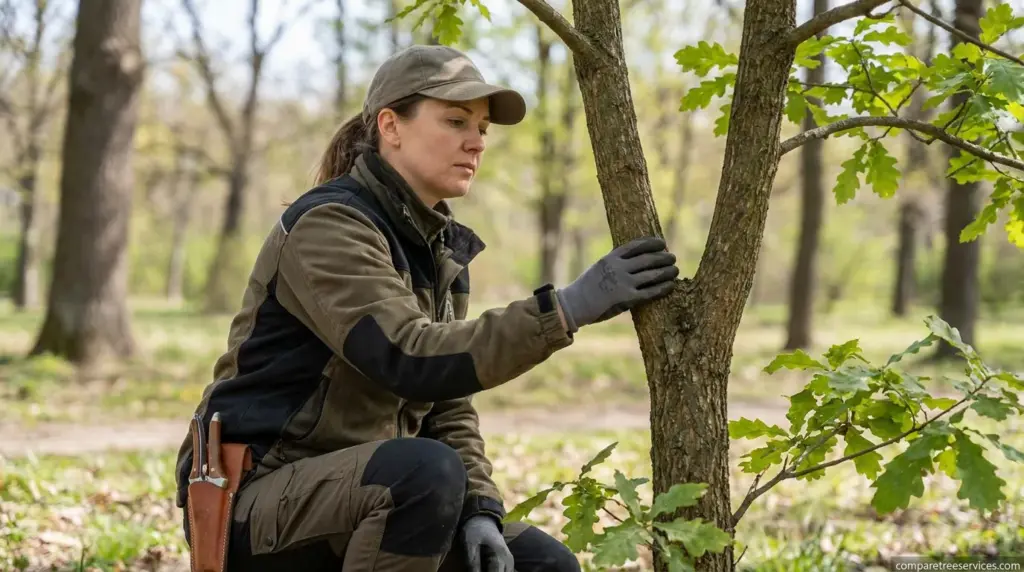
Start with the test this guide is built around rather than the lean you noticed from the driveway. Tap the trunk with the back of a hatchet or a mallet at several heights below chest level, and do it first on the face pointing at whatever the tree would hit: the house, the driveway, the path people actually use. A sound trunk answers sharp and even; a dull, resonant knock means the load-bearing wood behind it has decayed, and a hollow core in the strike zone is the failure that flattens something, no matter how straight the tree stands. Then drop your eyes to the ground and read it the same way. Soil that’s cracked, lifted, or heaving on one side of the base means the root plate is losing its grip, and a root plate letting go toward a target is a wholly different call than the same movement over open lawn. Look for disturbed, freshly moved earth, not the surface roots that show on any mature tree as it ages.
Deadwood, cavities, and weak unions in the canopy
Large dead branches lodged in an otherwise healthy canopy, sometimes called widowmakers, can fall without warning and without any storm to trigger it. Codominant stems, two roughly equal-sized trunks growing from close to the same point, with bark pinched between them rather than solid wood, form a weak union that splits under wind or ice load more often than a single, well-attached trunk does. A cavity or hollow section in the trunk reduces the wood available to resist bending forces, and the danger scales with how much of the cross-section is affected, not just whether a cavity exists at all.
Why proximity changes everything on this list
The same hazard sign carries completely different risk depending on what’s underneath it. A leaning, deadwood-heavy tree in the middle of an open field is a low-priority removal; the identical tree ten feet from a bedroom window or over a power line is an emergency. When triaging multiple trees on a property, rank by target proximity first and hazard signs second; the tree with the most signs isn’t necessarily the one to call about first if nothing valuable is near it. Our signs a tree needs to be removed guide covers the fuller save-or-remove decision once a hazard is confirmed, and our hazardous tree removal guide covers what a professional risk assessment and removal process actually involves. For what an urgent removal runs once a hazard is confirmed, see our emergency tree removal cost guide.

What we recommend
Three or more hazard signs on this list, especially root-plate movement combined with any lean at all, means a same-week professional risk assessment, not a wait-and-see. One isolated sign, some deadwood with a solid trunk and no lean, can usually wait for the next scheduled pruning visit. Never climb a tree you’ve already flagged as hazardous to inspect it up close; that’s precisely the tree a fall happens on, and it’s the arborist’s job to assess from the ground and by climbing under controlled conditions, not yours.
If the hazard is storm-related rather than a slow structural decline, see our storm damage tree cleanup guide for the safety sequence to follow before anyone approaches it.
Key takeaways
- A tree is dangerous when a structural sign lines up with a target; condition alone doesn’t determine risk.
- A new or increasing lean past roughly 15 percent, especially with root plate movement, is a same-week case [S1].
- Deadwood, weak unions, and cavities can all fail without a storm to trigger them.
- Rank multiple hazard trees by what’s underneath them first, hazard signs second.
- Verify insurance and credentials in person before hiring anyone for an urgent hazard removal.
Frequently asked questions
What are the warning signs a tree is about to fall?
A new or worsening lean, cracked or lifted soil at the base, large deadwood in the canopy, and a hollow sound when the trunk is tapped are the main signs. Any of these near a structure, line, or path is a priority case.
Does a leaning tree always mean it’s dangerous?
No. A lean that has held the same angle for years over firm, undisturbed ground is usually just how the tree grew. The one to worry about is the lean that appeared or steepened recently and shows cracked or heaving soil at the base, since that pairing points to roots actively tearing loose rather than a tree that simply grows crooked [S1].
How can I tell if a tree is hollow without cutting into it?
Tap the trunk at several heights with the back of a hatchet or a mallet. A solid trunk gives a sharp, consistent sound; a hollow or decayed section sounds dull and resonant. A visible cavity or crack confirms it further, and either warrants a professional assessment before any work near the tree.
Is a tree near power lines automatically considered dangerous?
Not automatically, but the consequences of failure are more severe, so the bar for calling a professional is lower. Any hazard sign on a tree near a line should move to the front of the line for assessment, and utility companies typically handle the line-clearance work directly.
Can a dangerous tree be saved with cabling or bracing?
Sometimes, for a weak union or a moderate lean with a sound trunk and healthy roots. Cabling doesn’t fix root plate failure or significant trunk decay; in those cases it delays rather than resolves the underlying problem.
Who do I call to assess whether a tree is dangerous?
An ISA Certified Arborist performing a formal risk assessment, not just a removal bid. A risk assessment evaluates the tree’s condition and what’s nearby; a bid only prices removing it, which isn’t the same question.
A formal risk assessment typically includes a visual inspection from the ground, sometimes a resistance drill or sounding test for internal decay, and a written rating tied to target proximity, which is different documentation than a same-day removal estimate. Crews performing hazard work should carry a certificate of insurance and follow ANSI Z133 safety standards, since removing an already-compromised tree carries more risk to the crew than a routine job.
How we built this guide
Hazard criteria draw on university extension guidance for tree risk assessment and federal storm-response safety guidance for the proximity checks. 4 sources, , reviewed by the CompareTreeServices editorial team.
How to tell if a tree is dangerous means checking the tree and what’s underneath it together, not the tree alone. A hazard sign next to nothing of value can wait; the same sign next to a house or a line can’t.
Sources
- [S1] How Do You Decide When to Remove a Tree?, University of Maryland Extension
- [S2] Is My Tree Dying?, University of Georgia Cooperative Extension
- [S3] Root Rots on Trees and Shrubs, University of Maryland Extension
- [S4] Storm/Flood and Hurricane Response, NIOSH/CDC
About this guide
Researched and maintained by the CompareTreeServices editorial team, alongside the public Google Business data behind our tracked directory. How the numbers are built: methodology · listing standards.