
Local 2026 Price Check: Tree Debris Removal Cost
The CompareTreeServices position: the ranges below are compiled from the published industry surveys cited, cross-checked against the sourced per-metro price rows in our own tracked dataset. Where our metro data disagrees with a national survey, we trust the metro data and say so. The published surveys cited below are our cross-check, not the source of that position (how the dataset is built: methodology).
The CompareTreeServices Take
We publish the numbers crews quote around because a homeowner with a baseline gets straighter bids. That is the whole thesis of this site, and it is why the directory and these guides live together.
| Job size | Typical cost | What drives it |
|---|---|---|
| Small pile (branches, one pickup load) | $150 to $200 per load | Volume and whether it’s neatly staged for pickup |
| Standard hauling job | $75 to $250 per dump trip | Load size, distance to disposal site, accessibility |
| On-site chipping | $100 to $150 per hour, one-hour minimum | Volume of brush, equipment already on-site |
| Larger cleanup (multiple trees, post-trim) | $200 to $800 | Number of trips, whether stump or log splitting is included |
| Storm-event cleanup | $75 to $500, plus 50 to 100 percent surge on urgent jobs | Regional demand spike, hazard conditions, crew scarcity |
Sources for this table: S2, S1, S3 in the Sources list below.
Table of Contents
Volume and Disposal Method Set the Baseline
How much debris you have, and how a crew gets rid of it, drives most of the price. Angi and HomeGuide both price standard hauling at $75 to $250 per dump trip, depending on load size, distance to the disposal site, and how accessible the debris is on your property [S1][S2]. Homewyse’s tree removal calculator separately lines out debris disposal at roughly $106 to $121 as part of a basic removal job, giving a useful cross-check on what the disposal portion alone typically runs [S4].
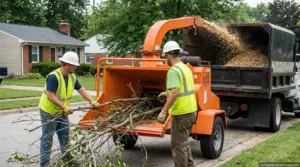
Chipping is usually the cheaper option per hour when there’s enough brush to justify it: HomeGuide prices on-site chipping at $100 to $150 an hour with a one-hour minimum, and most companies haul the resulting wood chips away for free since they’re lighter and more compact than raw branches [S2]. If you’d rather keep usable wood, log splitting for firewood runs about the same hourly rate, $50 to $90 per session according to LawnStarter’s tree service pricing [S5].
Where the Debris Sits Changes the Bill
A neatly stacked pile at the curb costs less to clear than debris scattered across a yard. Angi notes that if a crew has to walk to a far corner of your property, cut up a fallen tree, and drag the wood back to their truck, that added labor shows up in the total, especially on jobs billed hourly [S1]. Staging your own debris at the driveway or curb before a crew arrives is one of the few controllable ways to keep a hauling bill down.
Storm Cleanup Costs More, and Your City May Help
Storm-driven debris follows the same base pricing as routine cleanup, generally $75 to $500 depending on volume, but demand changes the math [S1][S2]. When a hurricane, ice storm, or major wind event drops debris across an entire region at once, emergency or same-day service commonly adds 50 to 100 percent above standard rates, since every local crew is booked solid [S1][S3]. For an actively hazardous tree still standing after a storm, that’s a different job entirely; see our emergency tree removal cost guide for that pricing, and our storm damage tree cleanup guide for broader yard recovery after severe weather.
There’s a real cost lever most homeowners miss here. In a declared disaster, a local government can request FEMA funding to pick up storm-related debris residents place at the curb, but FEMA has to approve it as an exception in the public interest, it’s not an automatic benefit, and homeowners are still responsible for moving debris from their own property to the curb themselves [S3]. Coverage generally excludes commercial property, and it only applies if your specific city or county requested it and FEMA approved that request for the storm in question [S3]. Check your city’s public works page after a major storm before paying for full hauling out of pocket.
Want a number specific to your job instead of a range? Our debris hauling cost calculator factors in load volume, debris type, and haul distance to build a working estimate.
What Add-On Services Cost
Debris cleanup rarely stands alone; here’s what commonly comes with it or gets added on:
| Add-on | Typical price |
|---|---|
| Stump grinding (if the tree itself is also coming down) | $2 to $5 per inch of stump diameter |
| Brush pile removal (full pickup-truck load) | $150 to $200 per load |
| Municipal yard-waste tipping fee (self-haul) | $20 to $75 per cubic yard |
| Log splitting for firewood | $50 to $90 |
| Emergency or after-hours premium | 50 to 100 percent above standard rates |
| Minimum call-out fee | Often applies even to a small load |
Sources for this table: S5, S6, S2, S1, S3 in the Sources list below.
How to Save Money on Tree Debris Removal
Stage debris at the curb or driveway before the crew arrives; a job billed hourly costs less when the crew isn’t walking your property to gather scattered branches [S1]. Ask whether chipping is cheaper than hauling for your specific pile, since a crew already on-site sometimes chips for less than a full dump run costs [S2]. If a storm caused the mess, check your city’s public works page for a scheduled curbside pickup program before hiring a private hauler for the whole job [S3]. And if you’re removing a tree anyway, bundle the debris haul into that same visit instead of scheduling cleanup separately; most crews price a combined job lower than two trips.
DIY vs. Hiring a Pro
Hauling small branches and yard debris you can lift safely is reasonable DIY work, and plenty of homeowners handle routine trimming cleanup themselves with a truck and a few trips to the dump. Renting a chipper for a one-time job is also an option if you have enough brush to justify it and know how to operate one safely, keeping hands and loose clothing well clear of the feed chute.
Storm debris changes the calculation. A downed tree still under tension, branches tangled in a power line, or a pile hiding a cracked or unstable trunk section is not a DIY cleanup job; call a professional and stay clear until the site is confirmed safe. If a power line is anywhere near the debris, don’t approach it yourself, call the utility company instead.
Getting Quotes from Tracked Pros
Debris jobs get quoted more inconsistently than a straight tree removal, so ask every bidder upfront whether they’re pricing by the load, by the hour, or with a flat estimate. Confirm a certificate of insurance covering general liability and workers’ comp before anyone works on your property, especially after a storm draws in traveling crews you haven’t tracked yourself.
Every pro in our directory has already been through our screening process, so you’re choosing between qualified crews instead of screening out the ones who shouldn’t be on your property.
Key Takeaways
- Tree debris removal typically costs $75 to $500 per job, with hauling priced at $75 to $250 per dump trip [S1][S2].
- Chipping runs $100 to $150 an hour and is often cheaper than hauling once there’s enough brush on-site to justify it [S2].
- Storm-event demand commonly adds 50 to 100 percent above standard pricing, since a single storm books every local crew at once [S1][S3].
- Staging debris at the curb before a crew arrives is one of the few controllable ways to lower a labor-billed job [S1].
- Some cities get free curbside storm-debris pickup approved through FEMA after a declared disaster, but it’s an exception FEMA has to grant, not a default benefit; check before paying for full private hauling [S3].
Frequently Asked Questions About Tree Debris Removal Costs
How much does tree debris removal cost?
Tree debris removal typically costs $75 to $500 per job, with hauling priced at $75 to $250 per dump trip and on-site chipping at $100 to $150 an hour [S1][S2]. Larger cleanups involving multiple trees or a full property can run $200 to $800 or more [S1][S2].
Is chipping cheaper than hauling debris away?
Often, yes, once there’s enough brush to justify the equipment being on-site. Chipping runs $100 to $150 an hour with a one-hour minimum, and most companies haul the resulting chips away at no extra charge [S2]. Hauling is usually the better option for a small load that doesn’t justify bringing in a chipper.
How much more does storm debris cleanup cost?
Storm debris follows the same base pricing as routine cleanup, but emergency or same-day service commonly adds 50 to 100 percent above standard rates because regional demand spikes after a storm [S1][S3]. Waiting a few days for a scheduled slot, if the debris isn’t blocking anything critical, usually costs less.
Will my city remove storm debris for free?
Sometimes, but it’s the exception, not the rule. After a declared disaster, a local government can request FEMA approval to pick up storm-related debris residents place at the curb, and you’re still responsible for moving it from your yard to the curb yourself [S3]. Coverage depends entirely on whether your specific city requested it and FEMA approved that request for the storm in question.
Can I haul tree debris away myself?
Small branches and yard debris you can lift safely are reasonable to haul yourself, and many municipal transfer stations charge a per-cubic-yard tipping fee for self-haul drop-off, typically $20 to $75 [S1]. A large pile, a downed tree still under tension, or anything near a power line should go to a professional instead.
Does tree removal include debris cleanup?
Not always by default. Debris disposal is commonly priced as its own component, roughly $106 to $121 within a basic removal job according to Homewyse’s calculator [S4]. Check your removal quote directly for whether hauling is already included.
What a Qualified Crew Brings
Loading and hauling should follow OSHA’s rules for lifting and equipment, and any crew running a wood chipper needs to follow ANSI Z133 safety standards and the manufacturer’s guarding requirements, since chippers are one of the more dangerous pieces of equipment on a routine job site. Insurance matters just as much here as on a felling job: the company should carry a certificate covering general liability and workers’ comp, particularly relevant after a storm when uninsured traveling crews tend to show up in damaged neighborhoods. If the job includes felling a hazard tree rather than just clearing what’s already down, an ISA Certified Arborist should be involved, and any digging for stump work still requires an 811 utility locate call first. A minimum call-out fee is standard even for a small debris job, and per-inch stump pricing applies separately if a stump grinder is part of the visit.
How We Price This Guide
We build every cost guide from published pricing data, not guesses. This page draws on 6 sources, including Angi, HomeGuide, Homewyse, LawnStarter, and FEMA’s Public Assistance program guidance, cross-checked wherever they overlap. Where sources disagreed by more than a small margin, we showed the full range instead of picking one number. Last and reviewed by the CompareTreeServices editorial team. Pricing shifts with fuel costs, disposal fees, and storm demand, so treat every number here as a planning range, not a quote. See our full pricing methodology for how we track sources.
Bottom line: tree debris removal cost tracks volume and disposal method more than anything else, and storm timing changes the number more than the debris itself does. A routine pickup-load of branches should land under $250 [S1][S2]; a full-yard storm cleanup costs more, though your city may cover part of it for free. Get quotes from two or three tracked pros, ask about staging debris yourself to cut labor time, and check your city’s storm-recovery page before paying for a job the public works department might handle at no cost.
Sources
- [S1] How Much Does Tree Debris Removal Cost? (2026 Data), Angi
- [S2] How Much Does Tree Debris Removal Cost? (2026), HomeGuide
- [S3] Tips for Removing Debris from Your Private Property, FEMA
- [S4] Cost to Remove Tree, 2026 Cost Calculator, Homewyse
- [S5] Pricing Guide: How Much Does Tree Removal Cost?, LawnStarter
- [S6] How Much Does Stump Grinding Cost? (2026), LawnStarter
About this guide
Researched and maintained by the CompareTreeServices editorial team, alongside the public Google Business data behind our tracked directory. How the numbers are built: methodology · listing standards.