
Here’s What You’ll Really Pay: Tree Removal and Property Value in 2026
Short answer: Research on urban trees finds larger trees in yards and as street trees can add roughly 3 to 15 percent to nearby home values [S1]. That value comes from healthy, well-placed trees, not from any tree regardless of condition; a hazardous or dead tree threatening a structure is a risk to value, not a source of it, and removing it is usually the value-protecting move.
The CompareTreeServices Take
Our position is boring and it works: verify insurance yourself, get scope in writing, and compare crews on demonstrated review volume rather than the loudest ad.
| Tree condition | Effect on property value |
|---|---|
| Healthy, mature, well-placed | Documented positive effect, often cited at 3 to 15 percent |
| Dead, dying, or diseased | Neutral to negative; a visible hazard can concern buyers and appraisers |
| Hazardous, threatening a structure | Negative; removal generally protects rather than reduces value |
| Removed responsibly with a replacement plan | Neutral to positive over time as new plantings mature |
Sources for this table: S1 in the Sources list below.
Table of Contents
What the research actually shows
Economists who study nonmarket environmental value have converged on a consistent finding: larger trees in yards and as street trees can add roughly 3 to 15 percent to home values across a neighborhood [S1]. One often-cited example modeled the market effect of street trees across an entire mid-size city and found the effect scaled into the billions in aggregate residential value, alongside a meaningful bump in potential property tax revenue [S1].
That’s a real, researched effect, and it’s specific to healthy, established trees, not landscaping in general and not trees regardless of their condition. The value comes from curb appeal, shade, and the mature, settled look a big tree gives a property, none of which apply to a standing dead tree or one with visible storm damage.
Where removal actually protects value instead of costing it
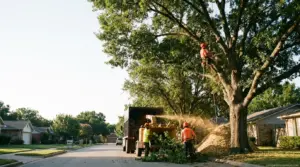
A hazardous tree is a different asset entirely. A large dead or dying tree visibly leaning toward a house, or one with obvious decay at the base, isn’t reading as an asset to a buyer or an appraiser; it’s reading as a deferred repair bill and a liability. Removing that tree, especially before it’s forced by a failure or storm damage, protects the sale price rather than reducing it.
This is the practical overlap between the property-value research and basic tree risk assessment logic: the trees that add the 3-to-15-percent value are healthy ones in good condition, and the trees that genuinely warrant removal under a documented risk-decision framework are a different population entirely [S2]. Removing a hazardous tree and keeping healthy mature trees aren’t in tension; they’re the same underlying principle applied to two different situations.
Should I remove a healthy tree to “clean up” a yard before selling?
Generally, no, unless it’s poorly placed relative to the house’s sightlines or genuinely overgrown for the lot. A healthy, mature tree is closer to a selling point than a chore, and removing one without a specific reason (disease, structural risk, or a genuine placement problem) trades a documented value driver for a bare yard with no upside. Our tree removal cost guide covers what removal itself runs, using the same national pricing data cited across this site, if there’s a genuine reason to take one down before listing [S3].
What to do instead of removing a healthy tree
If a mature tree has some issues, a partially dead limb, a lean that’s stable but visually concerning, or a canopy that’s grown into a power line’s clearance zone, targeted work often solves the problem without sacrificing the tree’s value contribution. Crown reduction, cabling and bracing for a structural weak point, or a licensed trim to restore clearance are all lower-cost, value-preserving alternatives to full removal for a tree that’s fundamentally healthy.
Key takeaways
- Healthy, mature trees are a documented asset, with research citing roughly 3 to 15 percent added home value from larger yard and street trees [S1].
- That value effect is specific to healthy, well-placed trees, not trees in any condition.
- A hazardous, dead, or structurally compromised tree is a liability, and removing it protects value rather than reducing it.
- Removing a healthy tree just to “clean up” a yard usually trades a value driver for no clear benefit.
- Crown reduction, cabling and bracing, or a licensed trim often preserve a healthy tree’s value while fixing a specific issue.
Frequently asked questions
Do trees really increase home value?
Yes, according to published nonmarket valuation research: larger trees in yards and as street trees are commonly cited as adding roughly 3 to 15 percent to home values across a neighborhood [S1]. The effect is tied to healthy, established, well-placed trees specifically.
Does removing a tree lower my property’s value?
It depends entirely on the tree. Removing a healthy, well-placed mature tree can reduce the curb appeal and shade benefits documented in property-value research. Removing a hazardous, dead, or structurally compromised tree generally protects value instead, since a visible hazard concerns buyers and appraisers more than an empty spot in the yard.
Should I remove a dying tree before selling my house?
Usually yes, if the tree is genuinely dying or hazardous rather than just aesthetically imperfect. A confirmed dead or dying tree reads as a liability to buyers, and addressing it before listing, rather than leaving it for the buyer to discover, is generally the stronger move. See our dead tree removal cost guide for pricing.
How much value do mature trees actually add?
Published research on urban tree valuation cites a range of roughly 3 to 15 percent added value from larger yard and street trees, based on modeling nonmarket environmental benefits alongside standard sales data [S1]. The exact figure varies by market, tree size, and placement.
Is it worth keeping a tree that needs regular maintenance?
Often yes, if the tree is fundamentally healthy and the maintenance is routine rather than a sign of decline. Ongoing crown reduction or occasional cabling and bracing on a healthy, valuable mature tree is usually a better trade than removing an asset that took decades to grow.
Will a tree risk assessment help before I sell?
Yes, especially for a large or older tree near the house. A documented risk assessment either clears the tree, supporting its value contribution with evidence, or identifies a real problem worth addressing before a buyer’s inspector finds it first. See our tree risk assessment guide for what that process covers.
A tree that’s genuinely earning its keep on a property, healthy trunk, intact root flare, good canopy density, is worth protecting with proper pruning to ANSI A300 standards rather than removing on a whim; a tree that’s failed that same evaluation, hollow trunk, root decay, DBH-scale cracking, is a different matter, and a crew handling that kind of removal near a house should carry a certificate of insurance covering general liability before cutting starts.
How we built this guide
Property-value figures are sourced from published nonmarket environmental valuation research rather than real estate marketing claims. This guide cites 3 sources, , reviewed by the CompareTreeServices editorial team.
Tree removal and property value aren’t opposed ideas once you separate the tree in question: keeping a healthy, well-placed mature tree protects a documented value driver, and removing a genuinely hazardous one protects value too, just from the other direction. The condition of the specific tree, not a blanket rule either way, is what should drive the decision.
Sources
- [S1] Local Economics: The Value of Trees, University of Washington College of the Environment
- [S2] How Do You Decide When to Remove a Tree?, University of Maryland Extension
- [S3] Pricing Guide: How Much Does Tree Removal Cost?, LawnStarter
About this guide
Researched and maintained by the CompareTreeServices editorial team, alongside the public Google Business data behind our tracked directory. How the numbers are built: methodology · listing standards.