
The Short, Honest Answer: What Is an Arborist? Meaning and What They Do
Short answer: An arborist is a tree care specialist trained in planting, pruning, diagnosing, and removing trees safely. The credential that proves it is ISA Certified Arborist, which requires verified experience and a 200-question exam. A tree service is the company you hire; an arborist is the qualified person, and the two aren’t automatically the same thing.
The CompareTreeServices Take
Our position is boring and it works: verify insurance yourself, get scope in writing, and compare crews on demonstrated review volume rather than the loudest ad.
| Term | What it actually means | Is it a tested credential? |
|---|---|---|
| Arborist | A tree care professional trained in tree biology, pruning, and safe removal | Not by itself, it’s a job description |
| ISA Certified Arborist | An individual who met ISA’s experience requirement and passed its exam | Yes, tested and renewed every 3 years |
| Board Certified Master Arborist | ISA’s advanced tier, for arborists with added experience, education, or credentials | Yes, built on top of Certified Arborist |
| Tree service | The company you hire; may or may not employ a Certified Arborist | No, it’s a business, not a qualification |
Table of Contents
What an arborist actually does
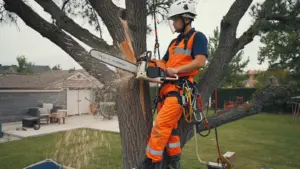
Day to day, an arborist prunes for structure and health rather than just to make a tree look tidy, diagnoses pest and disease problems, and removes trees that are dead, hazardous, or in the way of construction. Bigger jobs bring in climbing, rigging, or a crane for anything too large or too close to a structure to drop whole.
Arborists also handle work most tree cutters never touch: cabling and bracing to save a structurally weak but valuable tree, tree risk assessments for insurers or property managers, and consulting work like appraisals or reports for a legal dispute. The ISA exam tests these as separate domains, including Diagnosis and Treatment and Tree Risk, which is part of why the credential means something specific [S1].
The ISA Certified Arborist credential, in plain terms
Earning it takes three years of documented field experience (less with a relevant degree) and a passing score on ISA’s proctored exam, and the credential expires every three years without renewal [S1]. For the full exam breakdown, domain list, and how to verify someone’s status, see ISA Certified Arborist: what the credential requires.
Board Certified Master Arborist: the tier above Certified
Board Certified Master Arborist (BCMA) sits above the base credential. A candidate must already hold ISA Certified Arborist status and accumulate points across experience, formal education, and related credentials before they’re even eligible to sit for the exam [S2]. The BCMA exam runs longer, covers 17 knowledge areas grouped under science, practice, and management, and requires a 70 percent passing score [S2].
Few Certified Arborists go on to pursue it, which is part of why the letters carry weight on a bid for a large or high-value tree: cabling a heritage oak or diagnosing a construction-damaged root system is exactly the kind of call a BCMA is trained to make.
Arborist vs. tree service: why the difference matters
An arborist is a person with a tested credential. A tree service is a business, and plenty of tree services operate without a single Certified Arborist on staff. That’s not automatically disqualifying for routine trimming, but it matters more the bigger or riskier the job gets.
TCIA Accreditation, a separate company-level credential from the Tree Care Industry Association, actually requires accredited companies to keep the required number of ISA Certified Arborists on staff, plus proof of insurance and a documented safety program [S3]. That requirement is a useful gut check: a company with real arborists on staff builds its business around that fact and will say so without being asked. See how to choose a tree service for the full listing checks checklist, and our listing standards for what we require before listing anyone.
What arborists charge for common work like pruning
Arborist work is skilled labor, and it’s priced like it. Professional tree trimming runs $430 to $640 per tree on average, with large or hard-to-reach trees running well above that [S4]. See the tree trimming cost guide for a full breakdown by tree size, or run the numbers yourself with the tree trimming cost calculator. A separate consultation or diagnostic visit, rather than a trim or removal itself, is priced differently; our arborist cost guide covers hourly consultation rates and what a written report runs.
Hiring one the right way
Ask directly whether an ISA Certified Arborist will be on site for the job, not just listed on the company’s website. Get the credential number and confirm it through ISA’s own lookup tool before you sign anything [S5]. Then check insurance, get the scope of work in writing, and get a second quote if the job involves removal, cabling, or anything near a structure or power line.
Key takeaways
- An arborist is a credentialed individual; a tree service is the company, and the two aren’t automatically the same thing.
- ISA Certified Arborist requires verified experience plus a 200-question, 10-domain exam, and it expires every three years.
- Board Certified Master Arborist is the tier above Certified Arborist, requiring added points from experience, education, or other credentials.
- TCIA-Accredited companies must keep the required number of Certified Arborists on staff, on top of insurance and safety requirements.
- Always confirm a credential through ISA’s own verification tool before hiring for a large or risky job.
Frequently asked questions
What’s the difference between an arborist and a tree service?
An arborist is an individual with training and, ideally, a tested credential like ISA Certified Arborist. A tree service is the company you actually hire, and it may or may not employ anyone with that credential.
Do I need to hire a certified arborist, or is any tree company fine?
For routine pruning of a small, healthy tree, an experienced crew without formal certification can often do fine work. For diagnosis, removal near a structure, cabling, or anything involving a dispute or insurance claim, get an ISA Certified Arborist involved.
What does ISA Certified Arborist actually mean?
It means the person met a minimum experience requirement and passed a 200-question exam covering tree biology, pruning, diagnosis, and safety, administered by the International Society of Arboriculture [S1]. It’s renewed every three years, not issued once and forgotten.
Is Board Certified Master Arborist better than ISA Certified Arborist?
It’s a more advanced credential built on top of it. A candidate must already be a Certified Arborist and add years of experience, education, or related credentials before they can even sit for the BCMA exam [S2]. For most residential jobs, a Certified Arborist is sufficient; BCMA matters more for complex, high-value, or disputed cases.
Can an arborist also remove trees, or do they only prune?
Arborists handle removal too, including hazardous and structurally complex jobs that call for rigging or a crane. Pruning and diagnosis just tend to be the parts of the job that most clearly separate a trained arborist from general labor.
How do I verify someone is really a certified arborist?
Ask for their ISA credential number and run it through ISA’s own verification tool, which confirms whether the certification is current [S5]. Anyone can claim the title; only ISA’s records confirm it.
An arborist who cables a leaning heritage tree instead of removing it outright is making a judgment call backed by training, not guesswork: measuring trunk diameter at breast height (DBH) to scope the job, choosing crown reduction over a flush cut, and picking rigging or drop-cutting depending on clearance, with a crane-assisted removal in reserve for anything too large or too close to a structure for either. Stump grinders and wood chippers are standard equipment on a real crew, and a bucket truck often stands in for climbing gear on tall, open-grown trees. None of it should start without a certificate of insurance (COI) covering general liability and workers’ comp, a city tree permit where the local ordinance requires one, and an 811 call before any digging. The work itself follows ANSI A300 pruning standards and ANSI Z133 safety rules, the same framework OSHA references for the tree care industry.
How we built this guide
We verified certification requirements directly against ISA’s own program guides and checked pricing against a published cost study. This guide cites 5 sources, , reviewed by the CompareTreeServices editorial team.
What is an arborist, in one line? Someone whose tree care knowledge has been tested, not just claimed. Ask for the ISA Certified Arborist credential by name, confirm it’s real, and you’ve solved most of the hiring problem before a single branch comes down.
Sources
- [S1] International Society of Arboriculture, “ISA Certified Arborist Program Guide”
- [S2] International Society of Arboriculture, “ISA Board Certified Master Arborist Program Guide”
- [S3] Tree Care Industry Association, “TCIA Accreditation”
- [S4] LawnStarter, “How Much Does Tree Trimming Cost?”
- [S5] International Society of Arboriculture, “Verify a Credential”
About this guide
Researched and maintained by the CompareTreeServices editorial team, alongside the public Google Business data behind our tracked directory. How the numbers are built: methodology · listing standards.