
No Guesswork: When to Trim Trees
Short answer: Most deciduous trees are best trimmed in late winter, while they’re still dormant and bare. Spring-blooming trees and shrubs are the exception: trim those right after they finish flowering, not before. Oaks carry a real added risk, avoid pruning them during your region’s active oak wilt season, since fresh cuts attract the beetles that spread it [S2][S3].
The CompareTreeServices Take
Our position is boring and it works: verify insurance yourself, get scope in writing, and compare crews on demonstrated review volume rather than the loudest ad.
| Tree type | Best time to trim | Why |
|---|---|---|
| Most deciduous shade trees | Late winter, before bud break | Bare branches show structure; wounds close fast once spring growth starts |
| Spring-flowering trees and shrubs | Right after flowering ends | Next year’s buds form on this year’s new growth; pruning too early removes them |
| Oaks in oak wilt regions | Regional dormant window only, check local extension | Fresh wounds during beetle season can transmit oak wilt fungus |
| Dead, damaged, or storm-broken limbs | Anytime | Hazards do not wait for the right season |
| Evergreens | Late winter into early spring | Minimal true dormancy, but cold, dry-season cuts close cleanest |
Sources for this table: S1, S4, S2, S3 in the Sources list below.
Table of Contents
When to Trim Trees: The Dormant-Season Rule
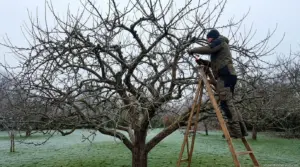
For most deciduous trees, late winter is the right window: the tree is dormant, the branch structure is easy to see without leaves in the way, and any cut has only a short wait before spring growth begins closing it over [S1]. Iowa State University Extension puts the ideal stretch at February through March for most species, before buds break [S1].
Pruning in this window also means less stress on the tree. Cutting live wood during peak summer growth pulls energy the tree would otherwise spend on leaves and roots; cutting during dormancy costs it nothing it’s actively using at that moment.
The Exception: Spring Bloomers Get Pruned After, Not Before
Trees and shrubs that flower early, lilac, forsythia, flowering cherry, and similar spring bloomers, break the dormant-season rule on purpose. These plants set next year’s flower buds on the growth they put on the previous summer, so a late-winter cut removes flower buds that already formed months ago and are just waiting to open [S4].
The fix is simple: prune spring bloomers within a couple of weeks after the flowers fade, not before. You lose nothing by waiting, and it gives the plant a full season to grow the wood that will carry next year’s blooms.
The Oak Wilt Exception
Oaks are the one common species where the general dormant-season rule can actively work against you without a regional check first. Oak wilt is a fungal disease spread mainly by sap-feeding beetles drawn to the smell of fresh wounds, pruning cuts included, during their active season, and the safe window narrows to a specific regional stretch rather than the general late-winter rule above [S2][S3]. Our trimming oak trees guide is the deeper resource here: it covers the full oak wilt calendar by region, the beetle biology driving it, and what to do if a storm forces an off-season cut.
Dead or Damaged Limbs Do Not Wait for a Season
Every rule above assumes the tree is otherwise healthy. A cracked, hanging, or storm-broken limb is a separate situation: hazards get removed on their own schedule, not the calendar’s. If a broken limb is large, high up, or hanging near a roof, driveway, or power line, that crosses into hazardous tree removal territory. Get a tree limb removal quote rather than reaching for a ladder yourself.
Professional tree trimming runs $430 to $640 per tree nationally, with small trees landing as low as $85 and large ones running well past $1,000 depending on size and access [S5]. See the tree trimming cost guide for the full breakdown by size and species, or use the tree trimming cost calculator below for a number closer to your own tree.
DIY vs. Hiring a Pro
Light, low pruning on a small ornamental tree or shrub, thin branches you can reach from the ground or a short stepladder, is a reasonable DIY job with clean, sharp hand tools. Cut just outside the branch collar, and don’t top a tree just to make it shorter; it grows back weaker and more crowded than before.
Anything at height, near a power line, or thicker than about your wrist belongs to a professional with the right gear. A crew brings pole saws, proper rigging, and often a bucket truck for branches you shouldn’t be reaching from a ladder at all.
Every pro in our directory has already been through how we track every pro, so you’re choosing between qualified crews, not gambling on whoever answers the phone first.
Key takeaways
- Most deciduous trees are best trimmed in late winter, while dormant and bare [S1].
- Spring-flowering trees and shrubs break that rule: prune them right after they finish blooming, not before [S4].
- Oaks carry a real added risk. Avoid pruning them during your region’s active oak wilt season, and check your local extension office for exact dates [S2][S3].
- Dead, cracked, or storm-damaged limbs get removed on their own schedule, regardless of season.
- A cut on a large or hard-to-reach limb belongs to a professional crew, not a homeowner on a ladder.
Frequently asked questions
When is the best time to trim trees overall?
For most deciduous trees, late winter, roughly February through March, while the tree is still dormant, is the best general window [S1]. The branch structure is easy to see without leaves, and any wound has only a short wait before spring growth starts closing it over.
What is the best time to trim trees that flower in spring?
Prune spring-flowering trees and shrubs right after their blooms fade, not during the dormant season. They set next year’s flower buds on the current season’s new growth, so pruning too early removes flowers that would otherwise open next year [S4].
When should you trim oak trees, and why does oak wilt matter?
Avoid pruning oaks during your region’s active oak wilt season. The disease spreads through sap-feeding beetles drawn to fresh wounds, and the exact risk window varies by state extension guidance [S2][S3]. See our trimming oak trees guide for the full regional calendar, or check your local extension office for the dates that apply where you live.
Can you trim a tree any time of year if a limb is dead or broken?
Yes. Dead, cracked, or storm-damaged limbs are a safety issue, not a seasonal one, and removing them doesn’t need to wait for dormant season. A large or high limb over a structure or power line should still go to a professional crew.
How often do trees need to be trimmed?
Most healthy shade trees do well with a checkup and light trim every three to five years; younger trees benefit from more frequent, lighter shaping to establish good structure early. A tree showing dead wood, crossing branches, or crowding a structure may need attention sooner than that.
Can trimming at the wrong time of year actually hurt a tree?
It can, though rarely on its own. Pruning a spring bloomer too early costs you a year of flowers, not the tree’s life. Pruning an oak during high-risk oak wilt season is the more serious version: a fresh wound during beetle season is a real, documented infection risk, not just a cosmetic one [S2][S3].
Whatever the species, a few entities show up on almost every trim job. A qualified crew works to the ANSI A300 pruning standard, follows ANSI Z133 and OSHA safety rules, and should carry a certificate of insurance with active general liability and workers’ comp before climbing anything on your property. Larger jobs sometimes call for crown reduction rather than heavy topping, and cities with a tree permit requirement or a heritage or protected tree ordinance may require sign-off before work starts on certain species, oak and elm among them in many municipalities.
How we built this guide
Timing guidance here comes from university and cooperative extension research, cross-checked across more than one region given how much oak wilt timing varies by state. Cost figures are cross-checked against published pricing data. This guide cites 5 sources, , reviewed by the CompareTreeServices editorial team.
Knowing when to trim trees is mostly a matter of matching the job to the season: dormancy for most species, right after bloom for spring flowers, and a real, regional gap for oaks in oak wilt country. When the calendar and a hazard disagree, the hazard wins every time.
Sources
- [S1] Proper Time to Prune Trees and Shrubs, Iowa State University Extension
- [S2] Pruning Oak Trees to Avoid Oak Wilt, Iowa State University Extension
- [S3] Prevent the Spread of Oak Wilt in Texas, Texas A&M AgriLife Extension
- [S4] Pruning Flowering Shrubs (FS1221), Rutgers New Jersey Agricultural Experiment Station
- [S5] How Much Does Tree Trimming Cost in 2026?, LawnStarter
About this guide
Researched and maintained by the CompareTreeServices editorial team, alongside the public Google Business data behind our tracked directory. How the numbers are built: methodology · listing standards.