
A 2026 Reality Check: Tree Limb Removal
Short answer: A single problem limb on an otherwise healthy tree is usually a limb-removal job, not a whole-tree removal. In most states, you can trim a neighbor’s branches back to your property line at your own expense, but rules on liability and who’s responsible for damage vary by state. Check locally instead of guessing.
The CompareTreeServices Take
The expensive mistake in tree work is almost never the hire, it is the wait. Trees fail on their own schedule; the homeowners who do well decide early, with a ranked shortlist already in hand.
| Sign | Limb removal likely enough | Whole tree likely needed |
|---|---|---|
| One dead or cracked limb, rest of canopy healthy | Yes | No |
| Limb overhanging a roof, driveway, or fence | Yes, if the rest of the tree checks out | Only if trunk or roots are also compromised |
| Trunk lean, root damage, or widespread canopy dieback | No | Yes |
| Mushrooms or fungal growth at the base | No | Yes, this points to root decay |
| Storm-split limb still attached at a major union | Sometimes, with cabling or bracing | Sometimes, if the union is fully split |
Table of Contents
When limb removal solves the problem
A single dead, cracked, or storm-damaged limb on a tree that’s otherwise healthy, solid trunk, no root issues, full canopy elsewhere, is exactly the case limb removal is built for. Removing the one problem branch clears the hazard without touching a tree that’s doing fine everywhere else. This is also the right call for a limb overhanging a roof, driveway, or walkway that’s simply in the wrong spot, not diseased or dying.
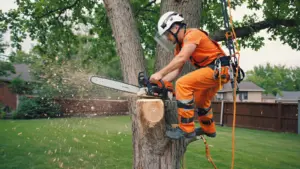
Access still matters even for a single limb. One hanging over a fence, a shed, or near a power line often needs rigging or a bucket truck rather than a straightforward cut, since a large limb can’t just be dropped where it lands.
When it’s not just the limb anymore
Limb removal stops being the answer once the rest of the tree shows real problems. Trunk lean, cracking bark, thin canopy elsewhere, or mushrooms and fungal growth at the base point to the whole tree, not just one limb. A lean beyond roughly 15 percent from vertical is generally treated as a removal factor in its own right, separate from any limb issue [S4]. See how to tell if a tree is dead for the specific signs, and hazardous tree removal for what actually qualifies a tree, not just a branch, as a real hazard.
A storm-split limb still hanging on at a major union is the trickier middle case. Sometimes cabling and bracing saves that union instead of removing the limb or the tree outright; see tree cabling and bracing for when that’s the right call versus when it isn’t.
Overhanging branches and neighbor property lines
This is genuinely state-dependent, so treat the general pattern here as orientation, not legal advice for your address. In most states, a property owner has the right to trim a neighbor’s overhanging branches back to the property line at their own expense, a self-help remedy that doesn’t require the neighbor’s permission for that limited trim [S1]. What varies by state is everything past that: whether you can enter the neighbor’s yard to do it, whether you can bill them for the cost, and what happens if a branch overhangs a structure rather than just airspace.
Ownership itself gets murkier for a tree growing directly on or near the property line. Some states treat a boundary tree as jointly owned, which changes who can authorize removal or major pruning without the other owner’s agreement [S2]. If a limb removal job involves a neighbor’s tree, confirm your state and local rules, or talk to an attorney, before cutting anything past the property line yourself.
Who’s responsible if an overhanging limb causes damage
Liability generally follows a similar state-varies pattern to overhanging branches themselves. The Insurance Information Institute frames it from the coverage side: your homeowners policy typically pays out no matter who owned the limb, but that source is explicit that poor maintenance isn’t covered, so a limb that was a known, unaddressed hazard beforehand is where liability questions start [S3]. See tree fell on house for the immediate steps if a limb or tree has already caused damage.
Getting limb removal done safely
Never climb a ladder to cut a large limb yourself, especially one near a roofline, fence, or power line; a limb’s weight and how it’s still attached to the tree make the fall direction harder to predict than it looks from the ground. Removing a single problem limb typically costs a fraction of full tree trimming rates, which run $430 to $640 per tree nationally for professional pruning work [S5]. See the tree branch removal cost guide for pricing specific to limb work.
Get a written quote before the work starts; see tree removal quote: how to get one and read the line items for what a fair estimate should include, even on a smaller limb job. Every pro in our directory has already cleared our listing checks process, so you’re hiring a crew that carries real insurance for work at height.
Key takeaways
- A single dead, damaged, or overhanging limb on an otherwise healthy tree is usually a limb-removal job, not a whole-tree removal.
- Trunk lean, root damage, or fungal growth at the base point to the whole tree, not just one branch.
- In most states, you can trim a neighbor’s overhanging branches back to your property line at your own expense, but rules vary past that point [S1].
- A tree growing directly on the property line may be jointly owned in some states, changing who can authorize its removal [S2].
- Liability for damage from a fallen limb often depends on whether it was already a known hazard, and the specifics vary by state [S3].
Frequently asked questions
How do I know if I need limb removal or full tree removal?
If the rest of the tree is healthy, solid trunk, full canopy, no root issues, a single problem limb is usually enough to remove. Trunk lean, thin canopy elsewhere, or mushrooms at the base point to the whole tree instead. See how to tell if a tree is dead for the specific signs.
Can I cut branches that hang over my property from a neighbor’s tree?
In most states, yes, you can trim branches back to your property line at your own expense without the neighbor’s permission [S1]. What you can’t do, and what varies by state, includes entering their yard to do it or billing them for the cost. This one varies too much to guess; check your local rules directly.
Who owns a tree growing right on the property line?
It depends on your state. Some states treat a true boundary tree as jointly owned by both property owners, which can require agreement from both before major pruning or removal [S2]. Check your local jurisdiction if the tree in question straddles the line.
Who is responsible if my neighbor’s limb falls and damages my property?
It generally depends on whether the limb was a known, unaddressed hazard beforehand or failed during a storm with no prior warning signs, and the exact rule varies by state [S3]. A healthy limb lost to a storm is often treated as the property owner’s own loss; a known hazard left unaddressed can shift liability.
Does removing one limb ever make a tree unstable?
Rarely, if it’s one limb on an otherwise sound tree and the cut is made properly at the branch collar. Removing multiple large limbs, or cutting into the main trunk’s structure, is a different situation and worth a certified arborist’s opinion first.
How much does tree limb removal cost compared to full removal?
A single limb typically costs a fraction of full tree removal, closer to standard trimming rates, which run $430 to $640 per tree nationally [S5]. See the tree branch removal cost guide for limb-specific pricing.
A limb job at height still touches the same core standards as any tree work: rigging or drop-cutting to control where a heavy section lands, a bucket truck for anything past ladder reach, and a wood chipper for the debris once it’s on the ground. DBH matters less here than on a full removal, but the crew should still carry a certificate of insurance covering general liability and workers’ comp, and larger jobs near a structure sometimes call for crane-assisted removal rather than climbing. Cities with a heritage or protected tree ordinance sometimes require a permit even for limb work on certain species, so check before assuming a smaller job is automatically exempt.
How we built this guide
Overhanging-branch and property-line guidance comes from university extension research and is presented as general orientation, not legal advice for a specific state; insurance and liability framing is cross-checked against Insurance Information Institute publications. This guide cites 5 sources, , reviewed by the CompareTreeServices editorial team.
Tree limb removal handles most single-branch problems without touching the rest of a healthy tree. The harder call is the property-line branch: know the general rule, confirm your state’s specifics, and get a written quote either way before a saw goes anywhere near it.
Sources
- [S1] Ohio State University Extension (Farm Office), “Trees Near Rural Property Boundaries: What Are the Laws?”
- [S2] Ohio State University Extension (Farm Office), “Trees Near Rural Property Boundaries: What Are the Laws?”
- [S3] Insurance Information Institute, “If a Tree Falls on Your House, Are You Covered?”
- [S4] University of Maryland Extension, “How Do You Decide When to Remove a Tree?”
- [S5] LawnStarter, “How Much Does Tree Trimming Cost?”
About this guide
Researched and maintained by the CompareTreeServices editorial team, alongside the public Google Business data behind our tracked directory. How the numbers are built: methodology · listing standards.