
The Real 2026 Numbers Behind Fallen Tree Removal Cost
The CompareTreeServices position: the ranges below are compiled from the published industry surveys cited, cross-checked against the sourced per-metro price rows in our own tracked dataset. Where our metro data disagrees with a national survey, we trust the metro data and say so. The published surveys cited below are our cross-check, not the source of that position (how the dataset is built: methodology).
The CompareTreeServices Take
Averages are where negotiations go to die. The spread in this guide matters more than the midpoint: know what pushes a job toward each end and you can hear an honest bid the moment it lands.
| Situation | Typical removal cost | Insurance status | What drives it |
|---|---|---|---|
| Already down, nothing damaged | $85 to $300 | Usually not covered; it’s on the property owner | No climbing, just cutting and hauling |
| Fell on your house or garage | Often covered up to $500 to $1,000 | Covered if caused by a covered peril like wind | Your insurer pays; you cover the deductible |
| Neighbor’s tree fell on your property | Same $500 to $1,000 removal cap applies | Your own policy usually pays first | Subrogation against the neighbor is possible |
| Your tree fell on a neighbor’s property | Same $500 to $1,000 range typically applies | Their policy usually pays first | Proven negligence on your part can shift the cost to you |
| Blocking your only driveway or exit | Up to $5,000 for urgent same-day service | Not covered unless tied to structural damage | Same-day dispatch premium |
Sources for this table: S1, S2, S4, S3, S5 in the Sources list below.
Table of Contents
What a Fallen Tree Actually Costs to Remove
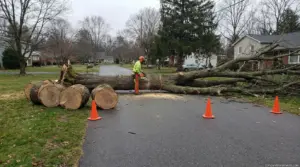
LawnStarter prices fallen tree removal at $85 to $300 on average, well under the cost of removing a standing tree the same size, since the crew skips the climbing and rigging and goes straight to cutting the trunk into sections and hauling it away [S1]. The price still scales with size and how much of the tree actually hit the ground versus how much is hung up in another tree or draped over a fence.
A fallen tree that’s still tangled in power lines or resting on a structure isn’t a simple cleanup job. That situation calls for a professional assessment before anyone touches it, not a same-day DIY chainsaw run.
Who Pays When a Tree Falls: You, Your Neighbor, or Insurance
Here’s the part most homeowners get wrong: insurance generally follows the damage, not the tree’s owner. The Insurance Information Institute notes that insurers typically don’t investigate which yard a tree originally grew in [S2]. If a tree, yours or a neighbor’s, falls on an insured structure due to a covered peril like wind or lightning, your own homeowners policy usually pays for the damage and the removal, up to a cap that GEICO puts at roughly $500 per tree and $1,000 per incident on many policies [S4].
The exception is negligence. Progressive notes that if the tree was visibly dead, rotting, or already reported as hazardous and the owner ignored it, liability can shift to that owner’s policy instead [S3]. If a fallen tree causes no damage at all, coverage usually disappears entirely: removing a tree that simply fell in your yard, even a neighbor’s dead tree, is typically your responsibility and cost, not theirs [S3].
When It’s an Emergency
A fallen tree blocking your only driveway, sitting on a car, or resting on a roofline is an urgent job, not a wait-and-see one. This Old House prices emergency or after-hours removal as high as $5,000 in genuinely urgent cases, since crews charge a premium for rushed scheduling [S5]. See our tree fell on house guide for what to do in the first hour, and our storm damage tree cleanup guide if you’re dealing with more than one downed tree after a storm.
If the tree isn’t blocking anything critical and nobody’s at risk, it’s usually cheaper to wait for a standard appointment than to pay the emergency premium.
Regional and Access Factors
A fallen tree in an open yard is a quick job almost anywhere. A fallen tree wedged against a fence, draped over a shed, or blocking a narrow driveway takes longer and costs more, the same way access affects a standing removal. Storm-prone regions see this kind of job constantly and often have crews specifically staffed for fast fallen-tree response, which can help keep emergency premiums in check compared to a market that rarely sees storm damage.
Want a number specific to your situation instead of a range? Our tree removal cost calculator uses height, species, and location to build a working estimate.
What Add-On Services Cost
| Add-on | Typical price |
|---|---|
| Hauling the wood away | $50 to $90 |
| Stump grinding (if the roots came up too) | $2 to $5 per inch of stump diameter |
| Emergency or after-hours premium | Up to $5,000 total for an urgent job |
| Insurance-covered removal (structure damage) | Up to $500 to $1,000 per policy cap |
Sources for this table: S1, S5, S2, S4 in the Sources list below.
How to Save Money on Fallen Tree Removal
Call your insurer before you call a tree company if a structure was hit; getting a claim number first can mean the difference between paying out of pocket and paying only your deductible. If nothing was damaged, get two or three quotes anyway, since fallen-tree pricing varies by crew even for a simple cleanup. Keep the wood yourself if you have a use for it and skip the hauling fee.
DIY vs. Hiring a Pro
A small fallen tree or branch, fully on the ground, clear of power lines, and not resting under tension against anything, is a reasonable DIY cleanup with a chainsaw and basic safety gear. A tree that’s hung up in another tree, leaning on a structure, tangled in a power line, or under spring tension from how it fell is not a DIY job under any circumstances; those situations kill experienced crews, let alone homeowners with a weekend chainsaw.
Getting Quotes from Tracked Pros
A fallen tree resting under tension needs a different read than a standing one, and an experienced crew assesses that before making the first cut. Ask for a certificate of insurance covering general liability and workers’ comp, and confirm the crew has actually handled storm-response work, not just routine removals.
Every pro in our directory has already cleared our listing checks checklist, so you’re choosing between qualified crews, not screening out the ones who shouldn’t be near a tree under tension.
Key Takeaways
- A fallen tree with no damage typically costs $85 to $300 to remove, well under the cost of a standing tree the same size [S1].
- Insurance generally follows the damage, not the tree’s owner; whoever’s structure was hit usually files the claim [S2].
- Many policies cap tree removal coverage at roughly $500 per tree and $1,000 per incident [S4].
- If a tree falls without damaging anything, removal is typically the property owner’s responsibility either way [S3].
- Emergency or after-hours removal for a tree blocking access can run as high as $5,000 [S5].
Frequently Asked Questions About Fallen Tree Removal Costs
How much does it cost to remove a fallen tree?
A fallen tree with no damage typically costs $85 to $300 to remove, since the crew skips climbing and rigging and goes straight to cutting and hauling [S1]. A tree that hit a structure or is tangled in power lines can cost more depending on the complexity of the cleanup.
Does homeowners insurance cover fallen tree removal?
Often, yes, if the tree damaged a covered structure due to a covered peril like wind or lightning. Coverage typically caps around $500 per tree and $1,000 per incident, according to GEICO [S4]. If the tree fell without damaging anything, removal usually isn’t covered.
Who pays if my neighbor’s tree falls on my property?
Your own homeowners policy usually pays first for damage and removal, regardless of whose tree it was, since insurers generally don’t investigate where a tree originated [S2]. If your neighbor knew the tree was hazardous and ignored it, your insurer may pursue their policy through subrogation.
Who pays if my tree falls on my neighbor’s property?
Their insurance policy typically pays first for the damage, the same way yours would if the situation were reversed [S3]. If your tree was visibly dead or you’d been warned it was hazardous, your insurer can be held liable instead once negligence is established.
Is a fallen tree always an emergency?
No. A fallen tree clear of structures, driveways, and power lines can usually wait for a standard appointment. It becomes urgent once it blocks your only exit, sits on a vehicle, or rests on a roofline; emergency service in those cases can run as high as $5,000 [S5].
What if the fallen tree didn’t damage anything?
Then insurance usually isn’t involved, and removal is the property owner’s responsibility and cost, regardless of whose tree it originally was [S3]. Get two or three quotes rather than paying the first number you’re given.
What a Qualified Crew Brings
A fallen tree looks simple from the street, but a qualified crew still runs its own hazard check before the first cut. The company should carry a certificate of insurance, general liability and workers’ comp both current, and the lead climber should hold an ISA Certified Arborist credential. Crews follow ANSI Z133 safety rules and OSHA’s guidance on trees under tension, called spring-pole hazards, since a fallen trunk pinned against another tree or a fence can release with force when cut in the wrong order. Pricing is typically quoted per job rather than per inch of trunk diameter once a tree is already down, and a wood chipper or bucket truck may still be needed if branches are hung up overhead. A good crew checks for tension and power line contact before the first cut, not after.
How We Price This Guide
We build every cost guide from published pricing data, not guesses. This page draws on 5 sources, including LawnStarter, the Insurance Information Institute, Progressive, GEICO, and This Old House, cross-checked wherever they overlap. Where sources disagreed, we showed the fuller range instead of picking one number. Last and reviewed by the CompareTreeServices editorial team. Insurance terms vary by policy and state, so treat every number here as a planning range, not a claims decision. See our full pricing methodology for how we track sources.
Call your insurer first if anything got hit. Fallen tree removal cost is usually modest on its own, $85 to $300 for a simple cleanup [S1], but the real number depends on whether a structure took the damage and whose policy ends up paying. Get quotes from two or three tracked pros either way, and don’t pay out of pocket for a claim your insurance should be covering.
Sources
- [S1] Pricing Guide: How Much Does Tree Removal Cost?, LawnStarter
- [S2] If a Tree Falls on Your House, Are You Covered?, Insurance Information Institute
- [S3] Does Home Insurance Cover Fallen Trees?, Progressive
- [S4] Does Homeowners Insurance Cover Tree Removal?, GEICO
- [S5] How Much Does Tree Removal Cost? (2026 Pricing), This Old House
About this guide
Researched and maintained by the CompareTreeServices editorial team, alongside the public Google Business data behind our tracked directory. How the numbers are built: methodology · listing standards.